One of the cool things about The Bioscope, is that it screens movies, that would otherwise not get a screening at South African movie theatres. Punk In Africa, is a documentary on punk music - from the late 1970's to 2011 (when it was filmed) - predominately in South Africa, a bit of Mozambique and Zimbabwe and a couple of mentions of the rest of Africa. The definition of punk is fluid; and covers - as far as the bands that are covered - rock, reggae, ska and a bit more. The common thread, be it bands from the way past such as National Wake; to the modern Fuzzigish and Hog Hoggidy Hog; is their focus on societal protest.
With a lot of archived footage; and interviews with the band members; there is a lot of interesting tidbits like, not only were there multi-racial punk bands in the 1980's - they were very popular in the townships. With a lot of focus on pre-1994 bands, there was off course quite a lot on racial segregation and the secret police and their impact on band line-ups and performances. But the real gems in the documentary are the archived video footage of the band performances. They have also now released a compilation of the music from the documentary, which should make interesting listening.
I haven't been to see a live rock band for a long time (outside concerts for big international artists). A number of venues that I knew off in Johannesburg has closed - and I think all of the clubs featured in the movie are now gone. The lack of clubs also implies that there has been a steady decline in the popularity of the music. Is it a matter of demographics, or a lack of money (for the band members) or simply a change in musical taste - I am not sure.
09 February 2012


06 February 2012
Getting out of Brussels (or Antwerp)...
I am thinking of going to see Rammstein in Antwerp next month (getting a scalper's ticket off course, since its all sold out). While getting to Antwerp required some creative thinking, to be fairly cheap; getting out is proving to be a lot more difficult (I need to be in Helsinki within 2 days of the Rammstein concert). I have tried a number of combinations; but the ticket prices are just astronimical (talking well into 400+ EUR price range) or at ridiculuous times.
At this rate, it just doesn't seem to be worth it ...
At this rate, it just doesn't seem to be worth it ...
Movie: The Girl with the Dragon Tattoo
For some reason, I have never got round to reading the series by Stieg Larsson; and also didn't get round to seeing the Swedish versions of the movies when it was released in South Africa last year. On the basis of this movie, the series is definitely on my list of books to read.
The direct Swedish translation of the title "Men Who Hate Women", is so much more descriptive of the plot, than the published title. It is a crime story where two unlikely characters try to solve a decades old mystery of a missing, presumed dead, girl from a very wealthy family. And in this roller coaster, we are introduced to even more deaths, which seem to follow a connected pattern.
Brilliantly acted, stunning cinematography and a great plot all contributes towards a great movie. Despite its length, it actually doesn't feel that long - it is the best type of storytelling; one that sucks you in completely.
04 February 2012
Improvisations on Nosferatu
The 1922 German silent horror movie, Nosferatu, has an interesting history (as per the Wikipedia article), and is one of the earliest adaptations of Bram Stoker's Dracula. As part of the Johannesburg International Mozart Festival, pianist Paul Hammer and saxophonist McCoy Mrubata, performed a musical score (don't think it was unrehearsed) accompanying the screening.
As a movie, Nosferatu was interesting in it self (though it seems the translated version does use the Dracula names and not the German substitutes). It does not come across as terrifying; and a lot of that is due to the explosion of vampire lore. The music was not terrifying either; and in fact made the movie a lot more comical than what was intended.
The venue was The Bioscope, an independent movie theatre in downtown Jo'burg (near Ellis Park). It's part of a wider artistic community including cafe's and a hotel. There are some interesting movies on their lineup ... thinking of exploring further on what it has to offer.
This is a great idea, and hopefully future editions of the festival showcase more of these collaborations.
02 February 2012
Fugard's Statements After an Arrest Under the Immorality Act
The recent furore over a DA youth poster, led to some interesting comments in the newspapers - some commented that it was a cheap marketing ploy, others commented against the naked models in the posters and off course there were commnents on the inter-racial couple itself. In many respects, the timing of the poster couldn't be a better advertisement for the staging of one of Athol Fugard's earliest plays.
The Fugard Theatre is off course an apt location for the performance of an Athol Fugard play (I believe that the theatre and the playright are not directly connected). Located in District Six, in a renovated old building; and in its young lifetime it has hosted some impressive acts (as advertised prominently on the lobby walls). It has a strange combination of formalism and informalism at the same time - M commented at the fact that it was probably the most well dressed crowd she had come across in Cape Town (and we were very much under dressed in t-shirts and jeans); while they also happily let you take your drinks from the bar into the theatre with no issues.
If you felt that the DA poster was inciteful, then don't bother with going to the play - not only is the play about inter-racial relationship (under apartheid) but the two main characters are also nude throughout. Set in a time when inter-racial relationships were illegal, the play is about the relationship between a single, white librarian (played by Bo Petersen) and a slightly younger, coloured school principal (played by Malefane Mosuhli). The set and lighting design is deceptively simple; but very effective - and you almost don't notice that all the actors are actually on stage when you go in to take your seat.
It starts of slowly; and almost too dramatically. But as the story evolves, it pulls the audience in and the flowery monologues disappear. It is not a happy story, and after the performance Mr Mosuhli commented that he hoped it didn't spoil my evening. It's a story that is still relevant; because, as the DA poster controversy revealed, we still have a long way to go. The play runs till 11 Feb, if you are in Cape Town - go. And if you aren't, maybe it will come to your neck of the woods.
30 January 2012
Music: Claire Phillips and Jimmy Dludlu
I think my first music concert I attended was Soweto String Quartet playing at the Kirstenbosch Botanical Gardens. It was an UCT RAG initiative, and I believe one of the first concerts ever in the gardens. Since then, there has been a regular season of music concerts in the gardens, drawing a wide range artists.
I am back in Cape Town, and since M is also here; we decided to go have a picnic in the late afternoon, while enjoying jazz legend Jimmy Dludlu (interestingly there is a German wikipedia page, but no English) and local artist Claire Phillips.
Despite the strong summer sun, the grounds were packed. We still managed to find some shade at the back, though that did reduce the visibility of the stage somewhat. The MC was annoying, in his attempt to say something meaningful about the artists, but instead just babbling on.
I am not sure if there is an exact "type" of music for Claire Phillips - it was a bit of jazz and a bit of pop. It sounded good; but it was not very spectacular. She did engage the audience a lot; and drew warm applause at the mention of her (and the band's) imminent second album.
Jimmy Dludlu's set started rather slowly, but slowly much of the audience started to stand-up and dance along. He played some of his big hits, with barely a pause between songs; and included a song from Michael Jackson which got high approval from the crowd.
It was not the most active concert I have been to; but it was a relaxing way to spend the afternoon/early evening. I do think both artists' music would be better experienced in a more intimate setting of a club, but it was still enjoyable. If you are in Cape Town, I can't think of many better ways of spending a Sunday afternoon in the summer.
18 January 2012
Table Mountain
I effectively left Cape Town in June 2007; but I have been back many times since. In fact, since April last year, I have spent a significant amount of my time in Cape Town. And I have been wanting to hike up Table Mountain every time; but never got round to it for some reason or another. In fact last time I was in Cape Town, I brought my backpack, my hiking boots, etc. and it rained ... in December!
Today, despite the hot weather, I decided I must walk up. So, I dumped all the contents of my office backpack, grabbed a large bottle of water and went off; in the late afternoon. There wasn't as much shade as I hoped for - but it was enough. And although I made some good time in the initial 70 - 80% of the way up; the last bit was a real struggle; though it seems more for my fitness than the heat (although I was soaked as if I just got out of the pool).
Despite the heat and the struggle; I really enjoyed the peace and quiet. Despite it still being the holiday season, there weren't too many people when I was going up. I assume the heat turned many people off. There was a hive of activity from the birds and insects; and I even spotted a small buck foraging on the cliffs of Platekloof Gorge; which is a very rare sight on the mountain.
In the end I decided to take the cable car down - I haven't been on it since my first time up the mountain, about 9 years ago. As the heat waned, a lot more visitors appeared, and the cable cars were very busy. I need to go up more often (and come down the gorge also!).
07 January 2012
Inside a Missile Factory

Gizmodo has a link to a Russian blogger, who "broke" into a working Russian missile factory and took a whole lot of pictures. Apparently there was no real security, and although it is a working factory, next to no workers. The photography of the decaying, mostly rusted plant is amazing ... wonder how long it will remain live ...
Gizmodo Link
Blog Link
06 January 2012
Mr Magic's Chameleon

On New Year's eve, the City of Johannesburg, holds a carnival on the streets of the CBD. Even though it is 8 years old, it does not seem to be very well supported. In fact, I would guess that UCT's RAG float procession gets more support than this carnival.

This year's theme was on the environment, and of the lot, Region B's Chameleon stood out. Designed by "Mr Magic", a magician by trade. The chameleon was built with simple materials - cloth, a few shopping trolleys and some bamboo - but like all magic tricks; the effect was brilliant. And the rationale was profound - the earth is changing, and we need to change our ways to halt the destructive effects of the change. The chameleon represents the change, and the fact that we can and must adapt to the change.


Incidentally, there seems to be quite a few "Mr Magic"s in Johannesburg ... leave a comment, and I will send his contact details to you ...
30 December 2011
The Personalisation of Computing
The Computer History Museum has a special feature on Steve Jobs, and one of the artifacts is a film clip from the early 1980s, where Steve Jobs talking about Apple. The Apple-II had been released, and this was before the modern PC era of Intel and Microsoft; so the insights are particularly interesting given what would come to be in the following 30 years.
The two highlights of his rather short talk (10 minutes with another 10 minutes of questions) was his observations on how the next generation will really be able to leverage the tool that is a personal computer; and why the personal computer was more powerful than the mini-computer or mainframes of the day. With the move to cloud computing, there is now a reversal of the personal computer in many respects - we are now going back to using shared resources and shared systems; although it is now far more accessible than the comparable systems of the day.
The video is here, and the full Steve Jobs special is here.
29 December 2011
Movie: The One Percent
Jamie Johnson, one of the descendants of the founders of multinational Johnson & Johnson, made an interesting documentary a few years ago on the growing wealth gap in America - particularly between the richest 1 percent and the rest. With the emergence of Occupy Wall Street and after the recession; the movie becomes quite interesting viewing.
The movie also resonant with South Africa - years earlier, Jamie's father, Jim, made a movie on the wide income disparity in Apartheid South Africa - something that has yet to be addressed after nearly 18 years of political freedom. The trappings of wealth in the US shown is eerily similar - rich estates with high security, broad open spaces, almost next to run down inner city slums; the huge political clout of the rich and the almost hopelessness of an escape for some.
There are some interesting interviews; especially with Nobel laureate Milton Friedman; but I am not really sure of what he was trying to achieve? To show that there are some rich people who care? Or to show that there are rich people who don't believe that there is a problem with a wealth gap? The most interesting criticisms, such as the effect on politics are not explored enough - while scenes such as that of Hurricane Katrina, while powerful does not seem to have any real point.
While interesting, it comes across as a half baked thesis - it could have been so much more.
You can watch the full movie on YouTube.
19 December 2011
Uncomfortable Shouting Match
After flying back to Johannesburg this evening, decided to meet with M at Eastgate for a snack/light supper. With Christmas round the corner, the mall was full, with all the shops open until 9pm. We decided to go to the Bread Basket - it is the only place in the mall with somewhat healthy food, and seating away from the crowds.
As we came in, it was quite clear that the manager (or owner of the franchise) was quite agitated. She kept on muttering and shouting at the employees, with no regard to the customers in the store. When I was in the queue to pay for our order (you pay and then sit down), she interrupted the cashier to get her to do something without apologising to the customer she was interrupting. From her mutterings, it seems that two of her more senior employees were out for their lunch break (it was about 7pm).
A short while later, the two employees returned; and each got dragged to her "office". There a one sided shouting match erupts, with a few expletives, a few "is this normal" etc. etc. In fact it was so loud, that even the baby that was crying (outside the store) was drowned out. A few customers who were browsing quietly left; while another old lady commented "has she gone mad". The other employees looked quite sheepish and tried to pretend that nothing was wrong. We learnt from our waitress that she was actually working 8am - 9pm, and I was quite impressed that she still had a smile on her face; and that also easily explains why someone can have a lunch break at 7pm!
It sort of brings an ethical conundrum - does one support a business where the owner/senior manager has no respect for their customers, and are happy to openly berate their employees; or should one support it because the employees are actually very warm and helpful? The manager/owner's conduct was disgraceful and it felt really uncomfortable to be there. I don't think I will go back there soon - despite how good their food is.
17 December 2011
Wonderful World
Despite the recent controversy, BBC still has some of the best nature documentaries. Assembled from a cross section of a number of such documentary series, BBC's ad of "Wonderful World" (with David Attenborough narrating Louis Armstrong's classic) captures the sentiment wonderfully.
13 December 2011
Mass Public Transport
South Africa in general does not have good mass public transport. Yes, there is Reya Vaya in Jo'burg, MyCiti in Cape Town, a host of bus companies and off course the ubiquitous taxi; but it is very dysfunctional if compared to some other countries - both developed and developing.
Good mass public transit (comprising a combination of trains, subways, trams and buses) is a combination of
Some of South Africa's efforts in this space has been good - Gautrain is a shining example - but they do not really tick all the boxes. For example, even though there are integrated Gautrain buses, their coverage is pretty small - and other public transport options, including taxis, are not integrated well.
In the US, Washington DC has a great public transport system, though its coverage is not as good, as say New York. The Atlantic has an interesting article on research looking at, not only the economical impact of the system, but also what the impact would be if the system didn't exist. The impacts are not surprising - more traffic, more parking requirements in the cities, more roads. But it is a nice parallel to why South Africa should perhaps spend a lot more and go towards an integrated mass public transport system. It does not need to be all state owned - there should be no reason why taxis and existing bus companies cannot be part of the integrated system. We cannot just continue to expand highways and build parking lots.
Good mass public transit (comprising a combination of trains, subways, trams and buses) is a combination of
- efficiency (helped by initiatives such as dedicated bus lanes and co-ordinated timing reducing waiting at stops),
- coverage (for example in Germany, despite the love of cars, it is possible to get almost anywhere by public transport),
- economical (public transport will not be faster, but should be cheaper) and
- good usability (easy to search for transport, availability at most times of the day, fairly frequent buses etc)
Some of South Africa's efforts in this space has been good - Gautrain is a shining example - but they do not really tick all the boxes. For example, even though there are integrated Gautrain buses, their coverage is pretty small - and other public transport options, including taxis, are not integrated well.
In the US, Washington DC has a great public transport system, though its coverage is not as good, as say New York. The Atlantic has an interesting article on research looking at, not only the economical impact of the system, but also what the impact would be if the system didn't exist. The impacts are not surprising - more traffic, more parking requirements in the cities, more roads. But it is a nice parallel to why South Africa should perhaps spend a lot more and go towards an integrated mass public transport system. It does not need to be all state owned - there should be no reason why taxis and existing bus companies cannot be part of the integrated system. We cannot just continue to expand highways and build parking lots.
04 December 2011
Nightwish's Imaginaerum
After a fairly long hiatus since their last studio album (Dark Passion Play was released about 4 years ago), Nightwish is back with a new album. And it was certainly worth the wait.
Dark Passion Play was the first album featuring Anette Olzon, replacing Tarja Turunen, whose operatic voice was certainly a key component of the Nightwish sound. I loved the album, but the sound had certainly changed, and this split off a number of fans. Part of the problem was that Anette's voice just didn't really fit all the tracks. It just did not seem to come across as metal.
All that is rectified in Imaginaerum. Anette's voice just fits the songs perfectly; and every song in the album brings something interesting. Starting off with the very first song, which starts off with the tune of an old music box, it is a rare Nightwish track in Suomi. Then there is the brilliant, jazzy "Slow, Love, Slow", which works surprisingly well for a metal album. The most interesting song, "Song of Myself", is one of the long Nightwish suites (14 minutes or so); based on the poem of the same name by Walt Whitman. In between, the songs features orchestral elements (the London Philharmonic), choral backing and the bagpipes from Dark Passion Play make a reappearance.
Imaginaerum was conceptually pieced together as a movie, telling the tale of an old songwriter suffering from dementia; and his recollections. The accompanying movie will be released sometime next year; certainly looking forward to it.
02 December 2011
Fry's Planet Word
In an earlier post, I mentioned the series on languages by the BBC, Fry's Planet Word, presented by author, comedian and actor Stephen Fry. For a number of reasons, I only got round to finishing the series today - watching the last 3 (of 5) in one go.
It is an absolutely stunning series; with each episode giving something to think about. Starting with the very essence of language, and exploring the concept that language is what sets homo sapiens apart from other animals (in episode 1), to the cultural and societal differences that have an impact on language and expression (in episode 2).
Episode 3 focused on "bad language", with gems such as why swearing is actually a primal reaction, and off course a liberal sprinkling of "fuck" (especially considering that it is a BBC documentary). Bad language is not only about swearing, but also about innuendos, propaganda, slang and derogatory words. The discussion on propaganda, not only on the traditional Nazi propaganda topics; but also the more recent "collateral damage" was particularly illuminating.
Episode 4 was on writing - exploring the history of writing, and how writing has fundamentally changed humnan society. Writing off course leads to books, and my argument on digital vs physical books was expressed and debated so much more elequently! Episode 5 rounded up on a more personal view on literature, from Joyce to Tolkien to Shakespeare to Orwel and Woodhouse.
The series is an exploration of language; on its universality and its regional nuances. It is thought provoking and manages to have interviews with a wide variety of very interesting people. It is certainly a gem in the long line of great BBC documentaries.
01 December 2011
The Economy and Business Travel
In the past few months, I have made almost weekly trips between Johannesburg and Cape Town; which has meant a lot of flights. It initially started around April, when the regularity was around every 2 - 3 weeks, but in the past 3 months; it has been every week. In comparison to previous years, I have spent a lot more time in airports than previous years.
Surprisingly, on my return flight this week; for the first time this year, I was upgraded to Business Class. It is surprising because of a simple reason - late last year, when I had a period of regular travel - my seat on every domestic flight was upgraded. Having sufficient "status" on frequent flyer programs has meant that I am often earlier in the queue to get upgraded - but upgrades require full planes; and flights are just not that full. Airports are certainly busy; but flights are not that full to the extent of having stand-by passengers; and often the middle rows are empty on the flights. This is an observation many of my frequent flyer colleagues have also made.
This brings me to the economy - South Africa, while not in a recession does not currently have a strong economy. And trade is a big indicator of a strong economy, as is a healthy business travel volume. And it is not because business is buckling down and getting on Kulula et al. - in fact my SAA and BA flights are sometimes cheaper that the "low cost" airlines; and the same observation of a few empty seats also apply to them.
25 November 2011
Foxconn
Techcrunch has a nice series on the future of Foxconn - the company behind the manufacturing of almost every major electronic gadget. It's an interesting read; although tinted with American expectations.
I find Foxconn city to be the most interesting discussion. In my opinion, it is almost the perfect realisation of the Utopian society/communist ideal - everyone has a job, every one has a place to stay, food, entertainment etc. What breaks this ideal off course is the fact that this is a city run by a conglomerate, who has taken the idea of economies of scale to the next level. But the efficient operation does give some credence to the view that business could operate cities more efficiently than politicians - but then, they don't have the same goals (or income sources).
I find Foxconn city to be the most interesting discussion. In my opinion, it is almost the perfect realisation of the Utopian society/communist ideal - everyone has a job, every one has a place to stay, food, entertainment etc. What breaks this ideal off course is the fact that this is a city run by a conglomerate, who has taken the idea of economies of scale to the next level. But the efficient operation does give some credence to the view that business could operate cities more efficiently than politicians - but then, they don't have the same goals (or income sources).
20 November 2011
Sardines in the bay
I had initially planned to go up Table Mountain this afternoon (on yet another trip to Cape Town). Unfortunately it was raining with the tablecloth on the mountain, so I decided to get some fish and chips from the take-away in Hout Bay's Mariner's Wharf; one of the best places to get fish and chips in Cape Town.
There was a lot of activity on the beach, with a number of fishermen catching fish using nets. The bay was full of sardines - and it was not only the fishermen having a blast - seals were having feast as were seagulls. In the clear water of the bay, the sardine shoals were clearly visible, and the fish bones littered the rocky edges and shallow areas of the beach - remnants of a higher tide.
Speaking to a few fishermen, it seems that this is a fairly irregular occasion, with at least one claiming this to be the first time ever. No matter - it is quite impressive to see. Some pics and commentary here, here and here.
12 November 2011
Woolworth's Cafe Cloud
The local British Airways (Comair) struck a deal with Woolworths a couple of years ago to supply the meals. I think that the food on Kulula is also from Woolies actually. Unless you fly business, airline food is usually rather crap; but there was promise of good things with Woolies - after all, the food options are the same as the ready to eat meals ...
However, except for the sandwiches or the snack food you get on the non breakfast/lunch/dinner flights; Woolies version of the airline food is actually quite bad. I have been traveling between Johannesburg and Cape Town a lot this past year, so I have had the opportunity to try out all the various options - and they are all horrible - especially the dinner options; which is inevitably something smothered in cheese. I have often eaten the same options as the ready to eat meals; and they are far superior - so where are they going wrong? I will go so far as to say that I have even been turned off from buying some of the ready to eat meals after a flight.
However, except for the sandwiches or the snack food you get on the non breakfast/lunch/dinner flights; Woolies version of the airline food is actually quite bad. I have been traveling between Johannesburg and Cape Town a lot this past year, so I have had the opportunity to try out all the various options - and they are all horrible - especially the dinner options; which is inevitably something smothered in cheese. I have often eaten the same options as the ready to eat meals; and they are far superior - so where are they going wrong? I will go so far as to say that I have even been turned off from buying some of the ready to eat meals after a flight.
09 November 2011
Most of us are Neanderthals
This article in The New Yorker, has a profile on how most persons in the world, other than Africans themselves have Neanderthal genes. This off course does have an implication (which is strangely not explored in the article) on the meaning of the political idea of race. The idea that modern humans (Homo Sapiens) won in the real species war/race consisting of at least tow, possibly more competing species in achieving dominance is interesting - the fact, that this could have arisen due to cross breeding is even more so.
The Earth's Children Series, by Jean M Auel explores the idea of human-neanderthal interaction; as well as the ostracisation of each others species - in an almost modern racial sense. While the entire series is fiction, a lot of the theories and concepts used in the story telling - especially with regards to human-neanderthal interaction, is seemingly on the ball. Since much of this was written before current evidence, especially a prophetic vision of the "mixed children" inheriting the earth is particularly interesting.
The New Yorker article is also notable for giving a wider overview of paleogenetics; which in itself is interesting. While the idea of recreating Jurassic Park is written off (apparently genetic material just won't survive that long) what is possible, and what is being revealed is very interesting.
07 November 2011
Digital vs Physical Books
I love books - those that you can hold, put on a bookshelf, use as a paperweight, leave it lying about in the lounge, use as a prop to hold other things in their place. I have a fair number of books, including a whole box (and more) unread ...
But the same things that I like about books, are the same things that make them difficult - they are heavy, they are unwieldy, difficult to carry around. I was on my way to Cape Town on the day that Walter Issacson's biography of Steve Jobs launched; and for me, it became an interesting decision on whether to buy the digital copy on iTunes or the hard cover at Exclusives (before boarding the plane).
There was an interesting contrast in pricing - the hardcover was approximately R300, while the iBooks version was USD 16, roughly 50% of the hardcover. This is exactly the type of business models I envisaged in my thesis on DRM - the digital copy, which is effectively licensed (as opposed to owned), has a lot more restrictions (e.g. restrictions on sharing, resale) compared to the physical copy; and one would expect a difference in cost. This cost difference extends to the US also (and is not just a result of exchange rates etc) - the retail price for the book is USD 35; though it can be found now at a much more discounted price.
In the end, I did buy the digital copy - mostly because I was going to be reading most of it while traveling - on the plane, on the Gautrain, in my hotel/BnB room. I like reading on my iPad - but strangely, this is the only book I have exclusively read on it (I have some "textbooks" on PDF that I have also read; though I actually prefer the physical book to the PDF). I do however miss it on my bookshelf ...
06 November 2011
Movie: Columbiana
Leon (The Professional), which introduced Natalie Portman, is one of my favorite movie. Columbiana, was promoted, locally at least, as the spiritual successor to Leon; and hence my interest in going to see it. Unfortunately, beyond the theme of a young girl wanting to learn how to kill, so that they can avenge their family's murders - there is very little in similarity.
It is a fairly good action movie; with enough guns and explosions; and the two assassinations that show off the skills of the heroine are quite well thought out (in terms of execution). But the movie does not have the same depth of character development, wit, or even dialogue. It is fun to watch; but nothing impressive.
It is a fairly good action movie; with enough guns and explosions; and the two assassinations that show off the skills of the heroine are quite well thought out (in terms of execution). But the movie does not have the same depth of character development, wit, or even dialogue. It is fun to watch; but nothing impressive.
04 November 2011
Exotic - JPO's 4th Season 5th Concert
Since the first draft of the 4th season program, published at the back of the program for the 3rd season - this is the concert I was really looking forward to. And I made sure, that I would be back from Cape Town in time to attend. Unfortunately, the general attendance of the concert was poor; with a lot of empty seats - they missed one of the best concerts in recent times for the JPO.
The concert started with The Overture from Rossini's opera, La Cenerentola (or Cinderella). A very lively piece, it defined the mood of the concert in general. It started in a somewhat halting fashion, as various instruments in the orchestra played short pieces; but it slowly merged together to really showcase orchestral music in full flow.
I had never heard a double bass concerto before, and this was the reason for my initial interest. The soloist, Venezuelan Edicson Ruiz, is a product of the El Sistema (as was the conductor, Christian Vásquez); and has a claim to fame as the youngest ever member of the Berlin Philharmonic; further piqued my interest. The first concerto, Hoffmeister's Violone Concerto, D major was interesting, but I wouldn't say remarkable. The second concerto, following the break Carl Ditters von Dittersdorf's Doublebass Concerto, E-flat major - oh wow. The first and third movements were fast and lively - but it is the second, middle movement, which is fairly slow (and quite somber) that really shows off the double bass as an instrument. It was quite mesmerising; and Edicson Ruiz is a very lively performer (unlike most classical soloists), shadow conducting the orchestra or swaying with the music, as if he was dancing with the double bass; while not performing. He really looked fully engaged with the music and nothing else - and it was a performance to behold.
After the classical European composers, the next set of pieces were from Argentinian composer Alberto Ginastera's ballet Estancia (The Ranch). The selection was particularly notably for the wide variety of percussion instruments, making the pieces very lively - as one would associate with Latin dances; and there was a rousing applause from the audience after the performance.
The last piece of the evening, was Mexican composer Arturo Márquez's Danzón no. 2. There is a romantic musical feel about it, but at the same time feels like it is part of a dance; or perhaps even a party. It was a great piece to end of the evening; and the performance got a well deserved standing ovation from the audience.
It is unfortunate that the hall wasn't packed - and perhaps, the JPO should consider holding cut price sales - half price or even lower, but only 1 hour before the show. It makes no sense to have an empty theater after all. There is one more performance - tonight at the ZK Matthews Hall in the Unisa campus. This is a concert that should not be missed ...
30 October 2011
It wasn't only RSA
Back in March, RSA Security, disclosed that it had been the target of a spear phishing attack, that led to the compromise of one of its crown jewels - the RSA SecureID token system. The attack was brilliant in its execution - a phishing email that was simple but did not look like a 419 Scam, usage of a zero day flaw in Adobe Flash, and a multi-level attack that slowly, but carefully infiltrated the organisation. The techniques themselves, as discussed here, are not that advanced - but it was certainly well thought out and put together.
In a recent blog post, the author discloses a number of other organisations that have also been attacked by the same set of attackers. The blog post is scant on details on the mechanisms deployed or even where the data comes from; but it does make interesting reading.
In a recent blog post, the author discloses a number of other organisations that have also been attacked by the same set of attackers. The blog post is scant on details on the mechanisms deployed or even where the data comes from; but it does make interesting reading.
29 October 2011
Yes, there is a group that runs the world
The idea of a group of people who secretly control the world, is staple fare of many fictional novels. From the Free Masons to the Illuminati, to various groups in between; the fiction is lined with controlling agendas, secret hangouts and off course rituals. It seems that it is not all fiction ...
As reported in New Scientist, a research group from ETH Zurich conducted an analysis of 43 060 corporations, untangling their capital ownership structures and creating a network of ownership of these corporations. Once all the networks are untangled, only 147 companies remain as the sole owner of capital - so the Illuminati group is not a small clandestine group; but it is far smaller than one would have thought.
It is not surprising that the list is dominated by financial companies; though there are a few notable exceptions - such as Walton Enterprises and China Petroleum. The data is understandably old, and thus the pecking order may have changed; but the order also shows why Lehman Brothers' failure was so catastrophic - in 2007, it was 34th most powerful corporation in the world in terms of economic power; and thus it is no wonder that its failure affected so many others globally.
Also interesting to see is the various nationalities of the companies represented; with one South African company, Old Mutual, on the list (although Old Mutual now claims to be a British company, although it is still largely based in South Africa in terms of workforce and revenue). There is not much detail beyond the top 50 companies, but on the top 50 list, I was surprised to see no South American or Indian companies, or even a lot more of the sovereign wealth funds from the Middle East.
The full paper can be found here. It does not mention any prospective future research areas, but given the impact of Lehman Brothers' failure, I would suggest that the next step should be to look at the impact of a network node failure. For example, should there be another failure of a major financial institute, what other corporates would be impacted?
Choir and Orchestra - JPO's 4th Season 4th Concert
M loves choral performances, so a full performance of Mozart's Mass was very enticing, regardless of the fact that neither of us have any religious persuasions, or even any catholic history. Last year's scheduled performance was postponed as it was felt that the choristers were not ready. There was a change in choir (now the Opera Africa choir) and soloists from Opera Africa; the only thing missing was a full blown organ (the orchestra had an electronic organ I think). It was a brilliant performance, with the soprano Kelebogile Boikanyo being particularly impressive. One change I would make in the program though - include the text and translation in the program!
In addition to the choral mass, the first part of the program featured Berio's Rendering for Orchestra. Based on Schubert's uncompleted 10th symphony, it was different to JPO's usual fare - more eerie (perhaps gearing up for Halloween), slow and rather unenergetic. I didn't really like it, but can't really work out why.
In addition to the choral mass, the first part of the program featured Berio's Rendering for Orchestra. Based on Schubert's uncompleted 10th symphony, it was different to JPO's usual fare - more eerie (perhaps gearing up for Halloween), slow and rather unenergetic. I didn't really like it, but can't really work out why.
23 October 2011
20th Century Pieces - JPO's 4th Season 3rd Concert
It was a hot Sunday afternoon; but instead of dozing off, I decided to go see the JPO playing in Pretoria. The Pretoria concerts are never full house, and the attendance was even sparser today.
The concert started off with the most recent piece - Benjamin Britten's Suite on English Folk Tunes, op.90. It was a medley of tunes, most notable in how certain movements focused on specific instruments - like the woodwind and percussion in one; or the violins in another. Not really sure of what to make of it really.
Cellist Maria Kliegel performed Elgar's Cello Concerto before the break. The piece is stunning - especially how the orchestra and the soloist feeds off each other in their various parts; and it was a brilliant performance from the soloist. I quite like the melancholic sound of the cello, and this piece captured the mood after World War 1 perfectly.
I did not like Shostakovich's 9th Symphony the previous time I heard it performed; perhaps I just didn't pay enough attention. The bassoon solo in the 4th movement, is absolutely haunting (supposed to capture the mood of a Jewish man praying, after WW2 according to the program); the brass sections give a resounding military feel, but at the same time, it seems more like a celebration than a mourning. Perhaps it was just a masterful performance - regardless, it was great to listen to; and totally reverses my opinion on the piece.
20 October 2011
Dining and Music
My sister chose "The Brass Bell" in Kalk Bay in a fairly random manner (well she wanted fish, and I wasn't that keen on Waterfront). Upon arriving we discovered that they were hosting live music on their "Bikini Deck", which offers the experience of seeing crashing waves up close (made more dramatic due to the high tide).
It was a fairly expensive cover charge, but it was Arno Carstens and Albert Frost, playing two sets (of approx 40 minutes each). The pop-rock music is hardly slow, background accompanying dinner music - but it did create quite a vibe. I am not too familiar with either soloists music, but there were quite a few Springbok Nude Girls classics; and I assume quite a few from Albert Frost also. His guitar playing was particularly impressive, and was certainly the highlight of the show - especially when he went into his Latin American inspired solos; which would have been perfectly at home in the Cuban restaurant next door.
The Brass Bell is a nice restaurant, but to be honest, I think it is better for its views and service than its actual food. Overall, I still prefer Hout Bay harbor restaurants for their seafood; but the music was a nice touch and thoroughly enjoyable.
17 October 2011
The Great Tech War
FastCompany has a brilliant article analysing the four tech giants (Apple, Facebook, Amazon and Google), and their turf war for supremacy - from social networks, to media to consumer products. It is strange to see an analysis of tech giants that excludes the traditional powers - Microsoft, IBM and Oracle - but then the traditional giants are more enterprise focused than mass market consumer focused; and the new powers have made money from the masses.
The article however does ignore non-American contenders. At this moment in time, that is correct - but I think the second tier of Foxconn, Samsung, Baidu, AliBaba, Softbank, HTC, etc. are going to provide significant challenge to these four, and will ultimately have a big say on the outcome in this "war". Be it Foxconn's mass production facilities, Samsung's silicon or the business platform provided by Ali Baba; there are many more companies that cannot be ignored.
The article however does ignore non-American contenders. At this moment in time, that is correct - but I think the second tier of Foxconn, Samsung, Baidu, AliBaba, Softbank, HTC, etc. are going to provide significant challenge to these four, and will ultimately have a big say on the outcome in this "war". Be it Foxconn's mass production facilities, Samsung's silicon or the business platform provided by Ali Baba; there are many more companies that cannot be ignored.
13 October 2011
Toll Road Suggestion
I have become quite addicted to 1.00 FTE, and the following comic (which is more that a year old) captures perfectly what I think we should do for the Gauteng Toll road - pay if the roads are free and uncongested; and get discounts if they are congested. Since the system should be able to calculate average speed, it should be easy to enforce also!

08 October 2011
Symphonic Rocks - Johannesburg
I came across last year's inaugural edition the week it was going to take place in Cape Town. By chance I was in Cape Town that week, but the concert was sold out. So, when I saw the concert pop up on Computicket, I bought the Jo'burg tickets with little hesitation. The concept is simple - take a few original South African music acts, and combine their music with a full orchestra. The result was stunning.
I have a new home theatre system, and have been testing my Blu Ray copy of Within Temptation's Black Symphony this past week - so it was easy to compare the results. The symphony definitely made the music better; and made a better show. Not all songs were suitable for orchestral performance though; but I think that can change if the bands themselves make bands with an orchestra in mind. The electronic instruments on stage also, at times, seemed to be louder than the orchestra instruments; dimming the effect. All together though, it was a great concert, and well produced; and all the credit to Andy Mac for putting it all together.
The first half of the concert featured CrashCarBurn, Zolani Maholo (of Freshlyground fame), Aro Carstens, Loyiso and Tumi & The Volume. Of the 5, I have heard a number of Freshlyground tracks with orchestral backing before; so it was not too strange; and Zolani's voice was stunning as expected. Arno Carsten's rendition of "Blue Eyes" with the orchestra was, in my opinion, the best song in the first half - with Tumi & The Volume's rap songs running a close second.
The second half started with Macstanley (the former Flat Stanley), followed by Locknville, Zebra & Giraffe and finally Ard Matthews. I did not know much about Locknville, but I had heard one of their songs on radio before. The transformation of electronic music pieces to a live instrumental performance was brilliant - and I think the guys could create an entire album in that fashion. Zebra & Giraffe were, apart from CrashCarBurn, the only other rock band, and they really brought out the "Symphonic Rock" vibe. I had not heard them perform live before, and I think I would really enjoy a full set from them. And finally Ard Matthews came to stage with a lot of jibes about his bungling of the national anthem; but he didn't bungle the Just Jinger songs; and it was a fitting end to the show.
I would definitely support an annual event of Symphonic Rocks; but I want some real rock bands. A full Springbok Nude Girls outfit, or a Seether set, or even full sets from bands such as Zebra & Giraffe would be preferable than the current format, in my opinion. The current format is definitely a lot more accessible (a lot of kids and older people in the audience), but then it is not a rock concert ...
07 October 2011
Old and New - JPO's 4th Season 1st Concert
Wednesday night kicked of the last JPO season of the year, and this season has an intriguing mix of music choices. I am particularly looking forward to Week 5 (1st week of Nov) for the Double Bass Concerto - I hope I can attend it. Wednesday night's attendance was rather poor - a pity, because it was a fantastic program.
The season started off with "Afroverture", a brand new composition by South African composer Simon Bhekathini Phelelani Mnomiya (known apparently for his choral works), which made its debut performance. The name was slightly misleading, because, beyond drum rhythyms, I did not hear too much African fusion; but the combination of the drums and brass was impressive - and I think it was a fantastic piece. The symphony for the evening, Schubert’s Symphony No. 3, was played in the first half of the program, following the Afroverture.
The last piece, is Beethoven's Fifth (and last) Piano Concerto, played by UCT Professor Francois du Toit. The third movement of the concerto is very popular, and I have heard it a number of times - especially on Classic FM. And while the last movement is impressive - I enjoyed the first movement even more. It was a masterful performance, and highly enjoyable performance.
06 October 2011
Goodbye Steve Jobs
He was a visionary - not only on gadgets, but the entire digital lifestyle experience. It was more than just iPods, iPhones, iPads and before that, the Mac. It was also Pixar, Disney, iTunes and OS X. It was about design and usability - not GHz and MB.
If I look back, what drove my attention to DRM, was the then recently launched iTunes Music store; with Fairplay DRM. That's what drove my interest into copyright law, into DRM; and perhaps security as a discipline itself ... for that, thank you.
If I look back, what drove my attention to DRM, was the then recently launched iTunes Music store; with Fairplay DRM. That's what drove my interest into copyright law, into DRM; and perhaps security as a discipline itself ... for that, thank you.
03 October 2011
Languages
Foreigners are often astounded by the fact that South Africa has 11 official languages. What is more interesting is asking different people, what they believe is the "average" number that are spoken by South Africans - and inevitably it breaks down racial lines. I have asked this question to a number of people I know - some like me speak only English fluently and understand the basics of another (most likely to be Afrikaans); others are fluent in two languages (usually English and Afrikaans) - while many more are fluent in a lot more, 4, 5 or even more. So the polyglot I once met in a Cape Town station is not that rare; though his language skills were far more diverse.
Stephen Fry has a very interesting series on BBC (no mention on where one can easily acquire it without watching BBC) called Fry's Planet Word, which explores the development of language - historically, culturally, physiologically etc. I have only watched one episode, but I think it is yet another BBC gem that is really worth watching.
Edit
Updated, full review can be found here.
02 October 2011
Zoo City
Published last year to great reviews and many awards, including the 2011 Arthur C Clarke Award, the science fiction/crime thriller is set in Johannesburg. Although set in a parallel universe, the exploration of Johannesburg itself by the heroine (Zinzi December) - from Hillbrow, through Houghton and Rosebank, to Sandton and Midrand - is fascinating as the storyline itself.
People who have committed crimes in this parallel universe are magically attached by an animal familiar, which then create a "load" on their shoulders per se. Zinzi December is an ex journalist, recovering drug addict with a sloth familiar; who has the magical ability to find "lost" items (not stolen), as well as write some brilliant 419 scam letters.
The story weaves the tales of Africa itself - from rising musical stars and producers/hanger-ons that seemingly exploit them, muti magic to various sub plots of refugees, including the tales of the conflict in the great lakes. In fact, the sub plots of the DRC - be it the journeys that the refugees take to escape from their hell to a lesser hell, or the stories about the conflicts themselves could easily become great books themselves.
Zoo City is a fantastic story, and I am now looking to find the earlier novel by Lauren Beukes, Moxyland.
27 September 2011
"Africa is not a country"
In the Mail & Guardian's blog platform, Percy Zvomuya has a wonderful piece on how Africa is often seen as one homogeneous country instead of being seen as a continent of 50+ countries. He gets a number of points spot on, specifically on how Africa is reported on in much of the Western media.
I would however argue that Africa is actually not alone - although other areas in the world are not necessarily bundled in one go. "America" for example, often encompasses Canada and the USA; while Europe usually refers to Western continental Europe, the Aussies often encompass New Zealand (except in the matter of Rugby or Cricket) and off course South America is more or less treated as a block also.
It is true that Africa is the largest of these blocks, and definitely the most diverse in terms of political and economical climate. But Africa also tries to portray itself as one in certain cases (esp when it comes to dealing with people such as Mugabe or more recently Gaddafi). But at very least, one should get the facts right, which is clearly not the case with regards to the reporting on the Zambian elections (as highlighted in the article).
21 September 2011
Takumi
I was introduced to Minato by Dave, but sadly after I had left Cape Town. Shortly after that, the owner and chef, Papa San, sold Minato and left South Africa. The quality of Minato slowly deteriorated.
A few months ago, Papa San, opened a new restaurant in Cape Town - Takumi. The decor is very modern, the place seems to be smaller - but the food is as good (if not better), the portions are big, and the house rules are only a little less crazy (you can now order more than once for example). I have been to a fair number of sushi restaurants in South Africa, and Takumi is the best I have been to.
I had booked a table tonight, and when we got there, it was full. So I would suggest, booking in advance - even if it is on the day. And bring an appetite ...
20 September 2011
Hi Jesus, Mohamed ...
Mohamed is a pretty common name, as is Jesus in Spanish speaking countries. Having a meeting with both of them in the room can be quite interesting to say the least. "Hi Jesus, Mohamed" is an email I wrote to them after the meeting which then led me to think of all the other prophet/gods I know - the gardener in our complex is "Moses", I know quite a few "Krishna"s and also one "Siddhartha" (i.e. Buddha before he was the enlightened one). Imagine getting all of them in one room ...
19 September 2011
Wingsuit Flying Video - Wow
Bungee jumping is a rush, hang gliding is rather sedate - but wingsuit flying combines the two to something insane; especially in the hands of Jeb Corliss. This YouTube video is simply insane. I want to try it, but I think it is far from being commercialised (and hence, safe and accessible).
18 September 2011
Gardening, Freddie Mercury, The Beatles and an Orchestra
Freddie Mercury's compositions (and Queen in general) often lend themselves well to orchestration, and have been performed by orchestras many times before. Likewise, there are a number of Beatle's hits that have been orchestrated. Last night, the Johannesburg Festival Orchestra, put up a selection of the hits from Freddie Mercury, Queen and The Beatles, dispersed with a few classical pieces in "In Tune with Nature". The concert was sponsored by Mayford seeds, and thus together with the concert, one also got a number of gardening tips thrown in. It seems that gardening was a good fit with the audience, as most raised their hands to indicate that they are gardeners.
The sold out show, started with "Bohemian Rhapsody", though only orchestral, before a few more contemporary classical pieces, some featuring soprano Magdalene Minnaar. The first half also featured pieces from the "Beatlecracker Suite" - an amalgamation of Tchaikovsky's Nutcracker Suite with a few popular Beatles's pieces. It was weird in how well the two musical pieces joined up, but remained individually distinguishable (at least in the pieces I knew both).
The star performance was from Loyiso Bala, who did a good job in singing some of the classic Queen tracks, and though he did not have the stage presence of Freddie Mercury, he was not a bad replacement. The concert finished with "Barcelona" - a piece I didn't know existed, but well worth watching on YouTube.
17 September 2011
Gautrain Notes
The Gautrain has become quite popular in the office - many of my colleagues make use of it for daily commute, and they are all quite impressed with it. One of them made the point that it is not actually faster - but it is a lot less stressful than driving, and according to him, a lot less expensive even without tolls. Others, often comment that every day they have not take the train (for example, because they have had to work much later or have to commute elsewhere), they have spent a lot longer on the road; so it also faster.
I have taken the commuter service only once, but on Wednesday/Thursday I had the opportunity to take the train to the airport. It was a rather unusual time for me - with an afternoon flight, so I got to see some "other" users of the Gautrain - a mother and daughter returning with shopping, some people going to the airport, and a few business men commuting between meetings. And on my return trip (around 19:15) I saw something that Vavi and co say the train doesn't support - the low wage worker (a security guard, not employed by Bombela) using the train.
Yes, the Gautrain does not extend to everywhere. Yes, the Gautrain fare structures need better work (why not use zones instead of fixed distance pricing). Yes, the times that the train current runs is inconvenient (I cannot make the first flight out of OR Tambo with the train, nor most of the evening flights) - but these can be fixed easily. The foundation itself is strong!
12 September 2011
Suikerbosrand
Just outside Heidelberg (in Gauteng, not Germany), Suikerbosrand is a fairly large nature reserve, and excellent hiking trails. I have been hiking (more like walking) the Bokmakiere day trails (there is a fork halfway with the routes being about 10.5 and 11.5 KM respectively) for over a year now, though I have not been there much this year.
Recent veld-fire (apparently in July) has completely transformed the trail area. Previously, grass on either side of the trail was, at times, over my head - and now completely burnt away. There is a stark contrast between the green sprouts and the untouched yellow veld on the opposite side of the valley. The change in landscape has also meant a change in wildlife - at least in the scenery of the wildlife. Previously, wildlife spotting along the trail was an occasional affair - yet, yesterday I saw an abundance of Zebra, Eland and Red Hartebeest - and perhaps even Wildebeest (in the distance). On the downside, the chatter of birds has diminished greatly with the loss of large shrubs and trees.
Recent veld-fire (apparently in July) has completely transformed the trail area. Previously, grass on either side of the trail was, at times, over my head - and now completely burnt away. There is a stark contrast between the green sprouts and the untouched yellow veld on the opposite side of the valley. The change in landscape has also meant a change in wildlife - at least in the scenery of the wildlife. Previously, wildlife spotting along the trail was an occasional affair - yet, yesterday I saw an abundance of Zebra, Eland and Red Hartebeest - and perhaps even Wildebeest (in the distance). On the downside, the chatter of birds has diminished greatly with the loss of large shrubs and trees.
11 September 2011
Movie: Incendies
I expected a "heavy" movie, but wasn't exactly sure of what this movie will be about. A woman dies (seemingly from some type of shock), and her twin young adult children are given a very strange missive in the will - for the daughter to find the father, who they believed was dead, and for the son to find the brother they didn't know existed.
Although never mentioned, the movie takes place in the backdrop of the brutal Lebanese civil war. As the daughter traces her roots in Lebanon, the parallel story of the mother is shown. It is a remarkable story of woman who fights for her ideals, though not necessarily the ideals of her community.
It is one of the best war movies I have ever seen. It does not hide the brutality, it does not hide the horrors, and at the same time it also highlights what often drives the horrors (in the tit-for-tat battles). Superbly acted, brilliantly written and directed, it is definitely a must see.
05 September 2011
Freddie Mercury
Today marks the 65th birthday anniversary of the legendary Queen frontman. Queen was in its prime before I was born, and in its second coming, I was a child - so there are not Queen memories per say.
I have however listened to many of the great hits, seen countless YouTube videos and concerts and even seen, what is left of Queen perform at the first 46664 concert in Cape Town. It is great to see some of the many tributes around the web, be it the official Google Doodle (which features some great animation, hopefully soon to be archived here), Google Blog post by Brian May, and Time's compilation of Freddie's 5 greatest videos. Most interesting in that lot, is Bohemian Rhapsody, performed with Freddie, in a ballet.
Most interestingly, for two days only, Queen's 1986 Concert Video - Live in Wembley will be streamed on Queen's official YouTube channel.
Queen is now very much part of popular culture, and it is certainly one of the bands (in its original lineup) that I would have really liked to have seen live.
03 September 2011
Interesting Challenge
Former F1 driver (and now commentator), David Coulthard is going to race against PS3 drivers of Gran Turismo 5. What makes this race interesting - Coulthard will drive a real car (Mercedes SLS AMG) on a real track, while the PS3 drivers will drive the same track, but virtually, using the virtual version of the car. To make it more honest, no one will be able to drive the track before the actual event.
It is an interesting concept, and would raise the interesting question - should there be someone faster than Coulthard, would they give him/her a remote control version of the SLS AMG to race to see whether the physics translate correctly?
The Telegraph will stream it live - hopefully there will be a downloadable version available.
30 August 2011
Movie: Rise of the Planet of the Apes
After the previous movies in this series, I was originally not too keen to watch this movie, but M was, so I went along. While the previous movies explored the world where the Apes had superseded humans in evolution to start running Earth, this movie explores how it got there in the first place. Like many Science Fiction "disaster" movies, it starts off with a well meaning scientist who invents a virulent drug, and things go wrong.
While John Lithgow plays an old man slowly wasting away with Alzheimer's, the real star of the movie is Andy Serkins as Caesar, the chimpanzee. While his performance as Gollum was sublime, I think this role was even better, and the high production values and the attention to detail certainly helps the movie a great deal. In fact the general "acting" of the apes was superior to that of the humans for most of the movie, perhaps signaling the message :) I am certainly glad that I went to see it, and it is a much more enjoyable movie when compared to its predecessors.
While John Lithgow plays an old man slowly wasting away with Alzheimer's, the real star of the movie is Andy Serkins as Caesar, the chimpanzee. While his performance as Gollum was sublime, I think this role was even better, and the high production values and the attention to detail certainly helps the movie a great deal. In fact the general "acting" of the apes was superior to that of the humans for most of the movie, perhaps signaling the message :) I am certainly glad that I went to see it, and it is a much more enjoyable movie when compared to its predecessors.
26 August 2011
All the Americans - JPO's 3rd Season, 6th Week
The final week of the JPO's 3rd Season featured only American composers; and while the Russian week (1st week) was quite traditional, this week had a lot of jazz influence. The JPO's Principal Guest Conductor, Bernhard Gueller was on the podium for the week.
The first piece of the evening was Gershwin's "An American in Paris", which was also played by the MIAGI Youth Orchestra in May this year. Overall, I think this performance was better - it felt a bit more alive, and the jazzy components stood out a lot more. It really gave the vibe of the Parisian cafe from before WW2 (as depicted often in movies).
The second piece was Gershwin's Piano Concerto in F, with Nina Schumann, (or rather Prof. Schumann, as her students would call her :)) at the keyboard. This piece had even more jazz influences, and was one of the best piano performances I have heard at the JPO.
Aaron Copland's "Corral Nocturne" from his Ballet Rodeo, was the most traditional piece of the evening - very soothing, and calm.
The last piece of the evening was Leonard Bernstein's Symphonic Dances from the "West Side Story". Taken from the Broadway hit (also scored by Bernstein), the Symphonic Dances give an orchestral performance of 9 songs from the musical (though they are not arranged in sequence of the story). Once again, there was a lot of "modern music" influence, a lot more Jazz in feel; and was definitely different to the traditional JPO fare. In some respects, I think the JPO should perform a lot more of the newer crossover pieces, as it opens up the concert to a much wider audience. I would particularly like to see scores from movies performed once a season to get a wider audience involved.
24 August 2011
Johan Botha Gala Concert
Johan Botha is probably South Africa's best known opera export, and is by all accounts a sought after tenor on the international opera circuit. So it was not surprising, that his one off gala concert in Johannesburg on Saturday had a full house. Supported by young South African opera singers, as well as the CT Opera Choir and the KZN Philharmonic Orchestra, he delivered a brilliant concert, and truly showed his class.
I am not a big fan of Opera, so I do not know all the concert pieces, and the background in the wider opera story - but it is easy to pick up on the ones I did know and compare it to other performances. I think the concert program could have done more in this regard, to be honest.
He had a number of encores, including an Afrikaans song (which got a wild applause from certain members of the audience), and finished off with the popular Nessun Dorma from Puccini's Turandot; and his final performance was better than the "concert" performance and is one of the best performances I have heard (though it doesn't really compare to the Pavarotti).
22 August 2011
Movie: Captain America: The First Avenger
Early Superman comics were just as nationalistic (there are comics showing Superman, fighting the Nazis); and Captain America was conceptualised at the height of World War 2; and largely takes place in that time period. A weak, but courageous young man, who wants to enroll, gets drafted into a covert bio-engineering program and is transformed into a super solider. He is first drafted in to raise funds for the war, but later leads the charge against the other super-soldier, mad scientist/Fuhrer wannabe.
As an action movie, it is passable - nothing brilliant, but not bad either. 3D is, as is expected, completely useless, with most of the movie employing next to no 3D effects. The explosions are big, there are car chases (and plane chases, and train chases); ticking bombs and off course beautiful women. So, quite an enjoyable movie to watch - but nothing special.
As an action movie, it is passable - nothing brilliant, but not bad either. 3D is, as is expected, completely useless, with most of the movie employing next to no 3D effects. The explosions are big, there are car chases (and plane chases, and train chases); ticking bombs and off course beautiful women. So, quite an enjoyable movie to watch - but nothing special.
Movie: The Perfect Host
It is hard to say much about this movie, without revealing the plot. An injured bank robber charms his way into the home of a man hosting a dinner party; except all is not what it seems. The movie is really notable for its brilliant character development (of the criminal, the host, and some of the other side characters) - and the brilliant acting of David Pierce (of Frasier fame).
14 August 2011
Nan Hua Temple

The town of Bronkhorstspruit is about 55 Km east of Pretoria (yet remarkably still part of Tshwane Municipality), and is a weird place to host the largest Buddhist centre in Africa. The history behind the placement, as detailed by the guide (I was only part of the group at the beginning) is part political (the deal was initiated as part of the mayor's trip to Taiwan), part visionary (an idea to enable cultural exchange, to bring Asia closer to Africa and also to initiate tourism) - but the peaceful surrounds of Bronkhorstspruit does bring some calm serenity to the place.
The Nan Hua Temple complex is part of a larger global Buddhist movement (BLIA) and also includes a number of initiatives in South Africa, including an IT academy, a retreat, meditation workshops, a monastery and various fundraising initiatives.

I first visited the temple, early last year, and the photos date back to then. Ever since, I have wanted to come back, but never really get round to it (it is after all quite a long trip). At least on a Sunday, there is free lunch (between 12pm and 1pm), so there is some motivation :)

It is a massive temple complex, not completely finished - and sometimes gives of a feeling of being decayed and not entirely well maintained. And the tourism plan doesn't seem to have completely worked out - as it feels pretty lonely, especially in the large temple halls. That in its own way may be its charm - similar temples in Asia (and I have been to fair number of them) are always bustling, and highly commercialised with vendor after vendor selling you either mementos or offerings. Nan Hua is far calmer and serene. It is well worth the visit - especially on a Sunday afternoon.

One of the highlights, is the many (1000?) armed Buddha, found at the back of the temple. Not sure of the mythological significance, but quite impressive. I am also not sure of the significance of the three Buddhas in the main temple, but they are impressively large, and also feature "Dharma protectors" guarding them on the sides. When I went last year, there was some youth activity going on, but yesterday there were hardly anyone there, leaving a lot more time to explore the main temple hall.

10 August 2011
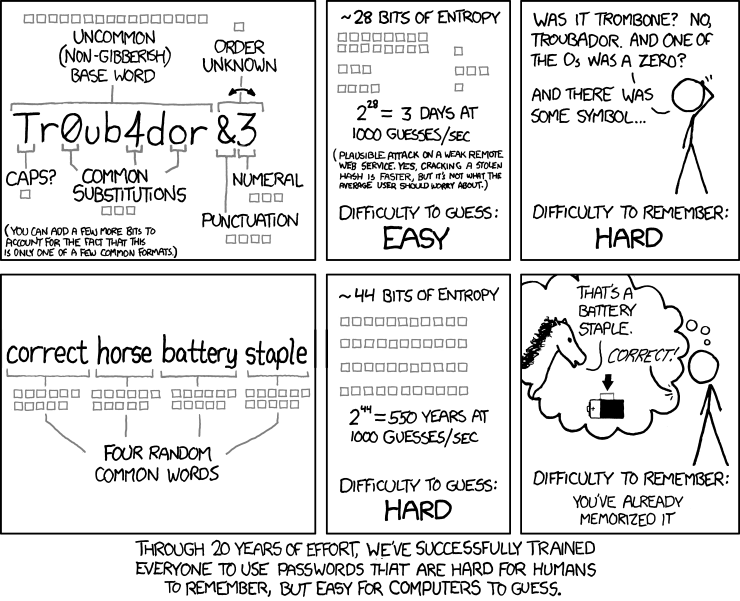
Password Strength
In one comic, xkcd has sumarised the core problem with passwords - they are difficult to remember, but are actually easy to crack. The use of phrases instead of passwords make a lot more sense, but most systems do not cater for phrases; and instead insist on complexities that make no sense.
08 August 2011
Enescu, Liszt and Dvořák - JPO's 3rd Season, 3rd Week
Gerard Korsten's last week at the helm of the JPO featured an interesting mix of musical styles. It was an almost full house yesterday afternoon at the ZK Matthews Hall at the UNISA campus, as two of Pretoria's best known classical music practitioners shared the stage.
The concert started with Enescu's Romanian Rhapsody No 1, is based on Romanian folk songs, and a drinking song in particular, as well as some folk dances. The origins are clearly reflected in the various changes in tempo throughout the piece (sort of mirroring a dance that goes faster and faster).
The 2011 Standard Bank Young Artist (for music) of the year, Ben Schoeman, was the soloist performing Liszt's Piano Concerto No 1. It was a stunning performance, that brought the home crowd to its feet.
Some season's back, the JPO played Dvořák famous "New World Symphony", and while the 7th Symphony is not as grand, it is probably a lot more traditional. It is fairly somber, and reminded me a lot of movie scores.
Half the JPO season is over, let's see if I can go to an entire season for a change.
05 August 2011
Not much of a summer
One of the things I was really looking forward to in this trip to Germany, was the summer weather, especially with the cold SA winter. The first two days were perfect summer weather, not too hot, a slight breeze over the Rhine, sunshine, all the good things needed to enjoy the long days of summer. I was told by many that this was an anomaly this year, and the weather has been rather crappy ... And for the rest of the trip it has been - humid, intermittent rain and a lot of cloud cover. It has felt more like Cape Town winter than an European summer :(
31 July 2011
Blacks Only
Hosted by one of South Africa's greatest stand-up comedians, David Kau, Blacks Only is a series featuring mostly black comedians, which is equally reflected in the audience. In fact David Kau started the show with a census of the audience - which was one of the largest audiences I have seen outside a music festival (there were 12 audience blocks, of about 360 seats in each block).
The show featured a variety of comics, Ugandan born David Kibuka (now from Fourways), American Will-E Robo, the token white guy Chris Forest and a number of "unknown" comics, getting their turn in the limelight. Mostly, the show was in English, although two comics were more versed in a combination of Tswana, Sotho, Zulu and Xhosa - and the general response from the audience clearly showed that they were very very funny!
The comics pulled no punches, offending people of all races, tribal groups, nationalities, not to mention politicians and celebrities. In fact some of the comic attacks even brought collective gasps from the audience (two highlights: calling Hector Petersen as the boy who couldn't duck fast enough, and giving Jacob Zuma something he had not experienced before, as part of Nelson Mandela day, by taking him to a Matric dance) - a show of how far they pushed.
Including the interval, the show was over 3 hours, and even after starting late, it was one of the best stand up comedy shows I have been to. Definitely a show to go to, the next time around!
28 July 2011
A lot of plucking - JPO's 3rd Season, 2nd Week
There was no overall theme in the second week, except that most of the pieces featured plucking by the strings of the orchestra. The first piece of the evening was Benjamin Britten's Simple Symphony, which Britten apparently composed in his early teens. It is a wonderful string orchestra piece, with my personal favourite being the second movement "Playful Pizzicato", which is entirely strummed by the full orchestra (see a YouTube performance of it here).
South African viola player, Gina Beukes, was the soloist performing two pieces - Max Bruch's "Romance in F Major for Viola and Orchestra" and Paganini's "Sonata Per Le Gran Viola e Orchestra". Of the two pieces, Paganini's piece was certainly more entertaining, and seemed to have a lot more complex and demanding. The final movement is particularly impressive, as the viola leads the orchestra to the climax, and was performed again as the encore.
The last piece was Haydn's "Symphony no 103 - Drum Roll", starts with a drum roll on the Timpani, and is quite upbeat and merry piece. It was not as impressive as the viola pieces or as interesting as Britten's simple symphony, but it was a nice, relaxed way to end the performance.
24 July 2011
All the Russians - JPO's 3rd Season, 1st Week
The new JPO season kicked off this week featuring a lot of Russians - Shostakovich's Festive Overture, Rachmaninoff's First Piano Concerto, with young Russian born soloist Boris Giltburg and finishing off with Mussorgsky's Pictures at an Exhibition. The conductor, Gerard Korsten, is one of the few really well known South African conductors, and will conduct two more weeks of this season.
The Festive Overture is loud, starting with great brass fanfare, and ending with equally loud percussion and brass; which was actually a general feature of the performance overall; and thus great in setting the mood.
Rachmaninoff's First Piano Concerto is not as well known as his second and third, and hopefully this signals that the JPO intends to cover the other two also in the future. While certainly not as loud as the accompanying pieces, the concerto is brilliant in how the piano and the rest of the orchestra comes together, and Boris' performance was brilliant in this regard. There was a short encore (a piece I didn't recognise) - very fast, and showed off his skills perfectly.
The Pictures at an Exhibition (originally for piano, but orchestrated by Ravel) feature a number of pieces inspired by paintings. In this respect, the JPO missed an opportunity in my opinion in not projecting pictures along with the concert, although I understand from the Wikipedia article, that not all the pictures survive. The pictures ends off with a raucous percussion set (where almost every percussion instrument seems to have gone crazy) in "The Bogatyr Gates (in the Capital in Kiev)".
The JPO plays three of its six week season at the ZK Matthews Hall in the UNISA campus in Pretoria, on Sunday afternoons. This is not as well attended as the Linder Auditorium performances, which I find strange - given that the UNISA environment seems to be a lot laid back, and not a bad way to spend Sunday afternoons. Perhaps, it is not as well known!
17 July 2011
Music: Isochronous
It has been quite a while since I have seen live music that is not classical music. Seeing that there was a band "Isochronous" playing on Saturday in Johannesburg, in the afternoon (meaning that the cold evening was not a deterrent) at Melrose Arch.
The music itself is pop-rock though the vocal style is a bit harder to categorise. Locally, The Parlatones is similar while Oasis would be the international equivalent I suppose. The music is very easy to listen to and they do perform well - although the crowd was fairly small.
The most interesting thing about the gig was the small kids dancing about really - it was quite funny to watch; especially how they seemed to make friends between themselves so easily.
The band has a number of videos on YouTube - and it is a band well worth supporting.
09 July 2011
South African National Youth Orchestra Concert
On a rather cold Wednesday evening, the South African National Youth Orchestra held its annual concert, conducted by Gerben Grooten. The main highlight of the concert was Benjamin Britten's "Young Person's Guide to the Orchestra", with narration provided by none other than Archbishop Desmond Tutu. The orchestra's website outlines a very interesting process in which the young musicians are taught and chosen to participate in the program, and there are some interesting collaboration projects.
You can see the trailer for the concert on YouTube:
The concert started with a short piece from South African composer John Simon, titled "Late Gothic Overture". The piece had its haunting edge; but was also quite lively with a lot of percussion and brass. It is apparently part of a larger symphony, but I haven't found a performance of it.
Benjamin Britten's "Young Person's Guide to the Orchestra" is an apt piece for a youth orchestra, and an audience with a number of people, including a lot of children, who do not regularly attend orchestral performances. The Arch's commentary was well paced, though he did miss his narration point on the french horns, with his trademark laughter (on trumpets, directly after the french horns) or his joy at saying "things that go bang". The finale of the piece, where all the instruments play together had an encore before the interval, and also as the encore for the concert itself.
The last piece was Shostakovich's 9th Symphony - which was rather dull to be honest. After the very energetic first half, it was a bit too mellow in my opinion. In the program, Shostakovich is quoted as saying "Musicians will love to play it and critics will delight in bashing it" - and perhaps that is the problem - it is a piece for those who play music more than for the listeners.
08 July 2011
Movie: X-Men: First Class
The movie is effectively a prequel showing the origins of what would become Professor X, Magneto and the mutant movement. Using the Cuban missile crisis as the backdrop, the movie tries to show clearly why the two mutant leaders have such fundamentally different outlook towards the rest of mankind.
It's well written and well paced; but it does not feel like a reboot of the series in the vein of Superman or Batman reboots. I am not sure even if it was supposed to be.
It's well written and well paced; but it does not feel like a reboot of the series in the vein of Superman or Batman reboots. I am not sure even if it was supposed to be.
20 June 2011
Anonymous and Lulzsec Declare war on Corruption
After hacking the sites (and systems) of the CIA, the FBI, various US government departments, various corporations (most notably SONY), Lulzsec, and Anonymous have released a joint call to arms - a Jihad if you will - against corruption. And like many Jihadi movements, many commentators have already labeled it as "cyber-terrorism". Their "press release" is quite impressive, and full of good intentions but some points come to mind.
Given the revelations over the weekend relating to South Africa's own arms deal corruption saga, I am quite keen to see the results of this mass action. And I don't think it is cyber terrorism, yet. And, I do have some grave doubts on whether any real prosecutions or changes to corporate and government activities will actually result from this.
- While the announcement itself asks for support for Wikileaks, how the evidence for corruption will be documented is not detailed. One of the standout features for Wikileaks is its impressive documentation, anonymisation and verification process. Simply releasing information is not enough, which leads to ...
- How will the supposed corruption evidence be proven. It is one thing to break into a "secure" network, and even to retrieve data. But the legitimacy of the data needs to be proven - sufficiently that it will be difficult to label as a fake. Considering the skills of the attackers, there is actually a higher burden of proof to ensure legitimacy of the data.
- Proving corruption will require a lot of corroborating evidence; and rarely will corruption be highlighted by a single data source. Furthermore, corroboration will require a number of disparate sources - e.g. an instruction via email linked to a bank account statement linked to an email on the success of the scheme. How many sources require infiltration before evidence is sufficient?
- Inevitably there will be innocent bystanders hurt in the process - either because they are unknowing mules or wrongly targeted. Verification problems yet again?
- Hacking into networks is illegal - and will remain illegal for the foreseeable future. Good intentions or not, this badly written, but informative article gives a good overview of the moral dilemmas awaiting the prospective hacker.
Given the revelations over the weekend relating to South Africa's own arms deal corruption saga, I am quite keen to see the results of this mass action. And I don't think it is cyber terrorism, yet. And, I do have some grave doubts on whether any real prosecutions or changes to corporate and government activities will actually result from this.
New Layout
I decided to try a new layout on this blog, with a few subtle changes on the template. It works well with my desktop, iPad and my laptop - but there may be some machines with low resolution that it doesn't work on.
19 June 2011
Movie: The Lincoln Lawyer
Most legal thrillers are based on "good" lawyers. Matthew McConaughey's character is initially difficult to like as a good lawyer - he is after all a lawyer that primarily defends petty criminals, often successfully. The story itself revolves around the lawyer coming to defend a rich man accused of rape, and the subplots start to unravel as he realises that there is a tricky catch-22 at play on maintaining his lawyer's pledge of client confidentiality and to uphold justice.
The movie is well acted, with some very impressive support actors, such as William Macy as the PI, it does tend to drag on a bit towards the end. It's a good story, well paced, and quite entertaining.
The movie is well acted, with some very impressive support actors, such as William Macy as the PI, it does tend to drag on a bit towards the end. It's a good story, well paced, and quite entertaining.
Movie: The Adjustment Bureau
Based on a Phillip K Dick novel, the story revolves around a politician (played by Matt Damon) who accidentally stumbles upon a shadow group of individuals who steer humanity's progress in life. What most humans consider to be accidents are in fact the effects of the meddling minders; geared to keep everyone to plan.
Effectively, in the debate around fate vs free will - the movie's premise is that free will does not exist - not because it cannot exist - but because humanity does not have the discipline to make effective use of it.
The movie is fairly divergent from the main plot of the original story; and does not really preach any particular morality or any particular religious doctrine (though the adjustment bureau being likened to angels or similar does exist). There is the fairly sinister view, that the higher power does not necessarily equate in terms of good and evil (for example, the politician's whole family was effectively terminated so that he can overcome adversity to become a new sort of politician); which does spin a new take on the fate vs choice debate.
Overall, it is a well scripted, entertaining movie.
Romeo & Juliet
I have never been to a ballet before, though not because of a lack of opportunity. S, bought tickets to "Sleeping Beauty" in 2008, but I was in Cape Town that week, and thus missed it. M was very keen to go to South African Ballet Theatre's production of Romeo and Juliet, and being the last weekend of the show, we went on Friday evening.
I love classical music, and Prokofiev's score for Romeo & Juliet is quite impressive - given the relatively small orchestra that accompanied the ballet. The music does provide a great backdrop to the story (quite truncated from Shakespeare's version). In addition to the music, the stage, props and costumes were spectacular - and are apparently based on the original South African production of the ballet in the 1960s!
As for the ballet itself - I wasn't too impressed. I am not a big fan of dance productions - I just don't understand it. Although some of the ballet scenes were easy to decipher - especially the fairly spectacular sword fights - in my opinion, the ballet alone will not be able to portray the story. Perhaps, it was just not a good production - but the same holds for other dance theatre I have been to.
16 June 2011
June 16

June 16 is certainly on of the defining moments in South African history, and the Hector Petersen musuem in Soweto is a great memorial to the children that signaled the end of apartheid. In fact the whole Vilikazi Street precinct is a great memorial, and very much worth the visit.
Subscribe to:
Posts (Atom)