About Me

I ramble about a number of things - but travel experiences, movies and music feature prominently. See my label cloud for a better idea. All comnments and opinions on this blog are my own, and do not in any way reflect the opinions/position of my employer (past/current/future).
Showing posts with label turkey. Show all posts

29 March 2014

Thoughts on Lesvos

Although it is the third largest island in Greece, Lesvos, in South African terms, is actually quite small. The distance between Mytilini on the east and Sigiri on the west is only about 100km, which makes the island the size of Johannesburg! The island is however very hilly (given its volcanic history) and thus the roads are very twisty, with some spectacular views across lush valleys and the blue sea; but traveling times are long.

Despite the relative amount of space, the villages and towns are crowded, with small, twisty streets. The streets come alive in the morning and evening, with some streets closed off to motor vehicles. But, it is otherwise quite relaxed with little activity. There is a "siesta" period after lunch, lasting about 4 hours - and we have been caught out, as even cafés and restaurants have closed given that it's off peak season.

The island's industry is largely agricultural, with olives (and olive oil) and ouzo being its main products. The economy however is in trouble, and many shops are closing down. In conversation with one shopkeeper yesterday, he said that he is trying to close down in a month, not even waiting for tourist season. What he will do afterwards he doesn't know. 

There is a sense of despair and despondency around in the shops; probably due to the economy. Shopkeepers and shop attendants often come across as grumpy or disinterested; as if they don't care about customers. Inevitably they have a sale, and it probably is a closing down sale.

While the Turkish economy is certainly not as vibrant as it used to be; the situation in Lesvos is a stark contrast to the vibrancy across the sea. Whereas Troy and Pergamon had bus loads of tourists, we didn't come across a single other visitor - Greek or otherwise - in any of the attractions we visited. 

It is not as if there is nothing to see or do here - and many of the attractions on the Turkish side are inherently linked to Lesvos. Yet, Turkish tour operators have got something right, or the Lesvos municipality has for something wrong. 

While the overall Greek economy certainly influences Lesvos, there should surely be more positive impact with it's historical and geographical closeness to Turkey. I am not sure why it doesn't - it could be due to Euro or bilateral politics - but it has certainly impacted Lesvians far more than their Turkish neighbors across the sea.


Political Protests

Across Mytilini there is graffiti on the walls, many with political overtones. The graffiti in Greek is not as easy to decipher, but pictures of Merkel or one of the political parties are recognisable. The other interesting pieces relate to Turkey, and the graffiti artists support of the Turks against their prime minister Erdogan and the current ruling party. 

Given the closeness of the Lesvos to Turkey, it is not too surprising - but this is a level of discourse that is missing in South Africa. After all, we don't see a lot of political commentary in graffiti in South Africa, let alone protestations against Mugabe or King Mswati.


27 March 2014

Crossing Over ... To Europe

When I started researching the trip, I had wanted to island hop across the Aegean from Athens to Istanbul. Unfortunately, that is only feasible between May and September, as the ferries at other times is quite limited. Thus, we only have one substantial ferry trip - crossing from Turkey to Greece. 

The trip is quite uneventful, even though the sea was a bit choppy. The Turkish ferry company, Turyol, provides a daily ferry between Ayvalik and Mytilini; and their customer service over email was particularly impressive. The cost of 20 Euros, for one way, was also very reasonable.

Tge customs check on both the Greek and Turkish side were far more intense than airport checks. I suppose it is easier to smuggle goods via sea - but at least the officials were friendly about it.


26 March 2014

Driving on the wrong side

In ally travels, I have never hired a car as part of my trip (outside South Africa). To get round Assos, Troy, Bergama and Ayvalik I considered getting a taxi service, but eventually settled on car hire. It was marginally cheaper, but it was the added flexibility that sealed the deal.

The car hire process, from South Africa was fairly smooth. The manager at Biber Evi recommended an English speaking agent, who organized a very well priced rental. The airport I arrived at was very small; and didn't have a rental agency, but the car was delivered to me. The agents didn't speak English well, but with Google Translate, it worked out.

There was some confusion with regards to the GPS; but the car rental agents basically decided to buy us one for use. The GPS system itself was not great, but it did get us to Behramkale. After that, I depended more on my iPhone :)

Driving in rural Turkey was mostly a breeze, though I kept wondering what to do with my left hand, having no gear column to rest it on. The roads are generally well kept, though there are inconsistencies in markings. For example, there were many traffic lights that had pedestrian crossings - some of these were marked at the traffic light, but others were considerably before or after the light! Speed limits were also difficult to identify - as the maximum on the open road was not marked. Not that other Turkish drivers seemed to care - most were driving considerably after than me regardless of the limit.

Unfortunately, except for the roads around Assos and to Troy, the route was fairly boring - though much of the coastal route was scenic. The distances were short enough not to matter much, and I would not drive in Istanbul - but perhaps I should consider car hire for future trips.

Internet access in Turkey

I was quite impressed with the speed and wide availability of Internet at the hotels. All of them provided free wifi as part of their service, and even in remote Behramkale, the speeds were great. Given the proximity to Europe, the speeds were not surprising, but the ubiquity was.

I am not a great user of Twitter, but I did notice the switch off. On Thursday evening it was working fine, but from Friday morning it was off. There was no error message - it seemed that the DNS queries were simply blocked. I did not try too hard to circumvent - I wasn't that interested; but it seems from news reports that it was easy to circumvent.

Ayvalik

A small coastal town, Ayvalik is one of the main ferry connections to Greece, with a daily Ferry to Mytilini on the island of Lesvos. Apparently, in summer it is very busy with tourists but at this time of the year, it's very much a sleepy town. We did not have enough time to really explore the old Greek town and its churches - but it was a pleasant end to Turkey.

Pergamon Asclepion

Probably the most notable citizen of Pergamon, is the noted physician and philosopher Gale (who I confessed I only learnt about in Bergama). Gale was born in Pergamon, studied at the Asclepion, and further in various other centres of the ancient world, before coming back to Pergamon; and gaining his fame as a brilliant doctor; before going to Rome to serve the Emperors. 

The Asclepion is part clinic/hospital, part health spa and part temple. Pergamon's Asclepion was famous even before Gale, and reportedly was one of the most famous in the ancient world at its peak in the Roman Empire.

I don't know why the Asclepion  went to ruin. Given its fame and function as a clinic, I would have expected it to last at into the Middle Ages, and perhaps even today. 

The Asclepion is in ruins now, and although the fountain still  seems to run, and the underground passages are still intact. The Romans had a theatre (not sure why, given the other theatres around) which is probably the most well preserved/restored piece of the environment.


25 March 2014

Pergamon's Acropolis

Pergamon was a Greek kingdom that arose from the splinters of Alexander's empire after his death. Although the kingdom ruled much of modern Turkey, it did not last long, and was eventually incorporated into the Roman Empire.

I first learnt of Pergamon about 7 years ago, when I visited the Pergamon Museum in Berlin. Since then, I have wanted to see Pergamon, in its original form.

The easiest way to get up to the acropolis is via a cable car. There are other parts of the acropolis that I missed out on, given that I went in the afternoon - but the main section is easy to cover in a few hours.

There are effectively two parts to the hilltop - the Greek part, which is not very well preserved including the place of the altar, palace walls, temples etc. and the Roman  part largely composed of a humongous temple and remnants of the artillery.

The construction itself is amazing. Like Machu Pichu or Kuelap in Peru, it is amazing that such a large town is built on a mountain top. The engineering to build the buildings, especially the Roman temple is amazing - as is the engineering that pumped water from over 40km (according to the audio guide) away.

The most imposing structure is the Roman Temple of Trajan, for two Roman emperors - Trajan and Hadrian, and Jupiter/Zeus. The supporting walls and vaults are an amazing piece of civil engineering that has fared far better than the temples above.

The Greek theatre complex, near the library (reputedly the second largest in antiquity) and temple of Athena is also amazing, especially with its views of the town below.

As for Pergamon's Altar - it is magnificent in Berlin, but you realize how big it must have been when the full size is seen; especially considering the 2trees that are now growing in the place of the altar.


Bergama

The town of Bergama itself is a small town, of little interest. But Bergama is the site of Pergamon, one of the most impressive late Greek kingdoms in Antiquity. And the ruins of Pergamon's acropolis dominate the modern town. There are some other attractions, such as the currently closed Red Basilica, but almost everything dates back to the time of Pergamon.


Assos Acropolis

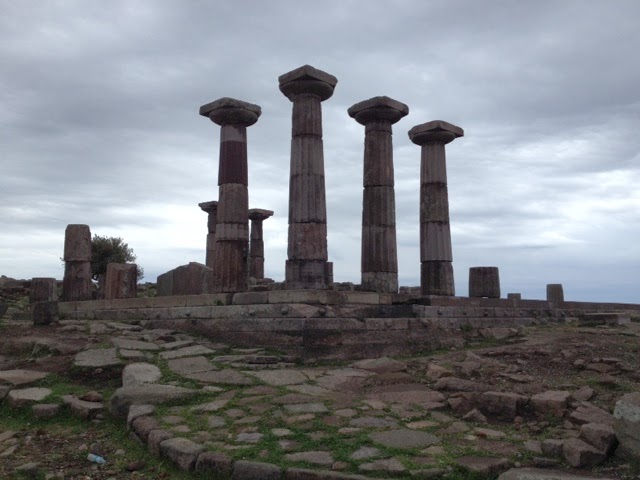
The Acropolis of Assos, with it's temple of Athena is the highlight of Assos. It's a majestic temple at the hilltop, although sadly much of it has disintegrated. The friezes are in museums all over the world, including the Louvre; but the temple stands in part with amazing views, including that of Lesvos across the sea.

The Byzantines had fortified the hilltop, and some of the towers, walls and a large cistern remain. The temple area has now been convered to a paid museum. At 8 TL, it's worth it.


24 March 2014

The ruins of Assos

Assos has some of the most accessible, and well preserved Greek ruins around this area. Much of it is freely accessible, and some it is partially restored. I love ruins - and these are some of the est to explore.

The ruins wrap around the hillside, and encompass a necropolis (effectively a cemetery), walls, towers, the town square and a stunning amphitheatre. 


Behramkale (Assos)

In about 500 BCE, Greek settlers founded a small town on the western shore of Turkey called Assos. The most famous resident is probably the philosopher Aristotle, but apart from that it is not that notable. At some point, the town was attacked by the Persians, and although Alexander would eventually drive them out, Assos became just another village and went to ruin. Eventually the Turks settled in the area, and their village; occupying much of the same area is called Behramkale.

It's a sleepy village, especially now in the off season. It has two parts, the larger village on the hillside, and a smaller port area. Apparently during the weekends in Summer and between July and September, it is full of tourists, with places booked out weeks in advance. In between, not much seems to happen.

We are staying at a nice boutique hotel - Biber Evi, or chilli house; with amazing views of the area, including the Aegean Sea and great accommodation. It's a nice relaxing space - and the ruins of the Greek town make it interesting place to explore.


The winding road between Behramkale and Ayvacik

The roads around the northern Aegean coast of Turkey are good - generally well kept and scenic. Filled with lush countryside, valleys and the occasional glimpses of the sea, it is overall a great drive.

The road connecting Behramkale and the nearest large town - Ayvacik - is a narrow, twisty mountain road with amazing views, and one of those amazing drives that scares and exhilarates. There are parts that are on mountain edges with no safety barriers; there are lush valleys and small villages; but above all an enjoyable drive.

Troy

Troy is one of the most famous cities of the ancient era - vividly captured in Homer's Iliad. Whether the battle happened, or whether Troy was brought down by a Trojan horse is a mystery, but Troy itself is a real city on the Aegean coast of Turkey, and now part of a small national park to protect the archeological dig site.

Troy has a history going back to over 3000 BCE, and there is evidence of a conquest that destroyed the city; which would fit Homer's tale. In fact many of features described by Homer is present and visible - from the massive walls, to the ramp where Achilles would perish. 

Troy is strategically located, and in later years Constantine even considered making it his capital - which would have changed the history of Istanbul dramatically. Thus, why it was eventually completely forgotten for so long is a mystery.

As for the Trojan horse, the replica suggests that it would be possible to craft a massive structure which could contain soldiers. Whether it happened or not, we will never know.


23 March 2014

Final thoughts on Istanbul

Istanbul has been one of my "places to go" for a log time, and I think 4 nights has been enough to just scratch the surface. It is a massive metropolis, and we effectively explored parts of 2 suburbs. The entire Asian side, yes with lesser tourist attractions, was just a pass through.

It is an interesting city, with a lot of busy energy. It is clean, and public transport is effective. Most people are friendly and it's generally a great atmosphere.

I would like to come back, but I would not stay in Sultanahmet or even really visit the area. There are many other experiences to have - but as an introduction to Istanbul, this was great!

Bosphorus Tour

Throughout Sultanahmet, there are hawkers selling tours of the Bosphorus, ranging from 15 Eur a person to over 50 Eur, for trips with museum stop overs. In fact there seem to be more tour hawkers than carpet sellers! 

Istanbul's ferry operator also offers a Bosphorus tour, although in less glamorous boats (they use standard ferries), and their long tour is the only one I saw that actually traversed the majority of the Bosphorus Straight. At 25 Liras, plus 10 Liras for a GPS enabled audio guide, it's a bargain.

The trip starts at the Eminounu docks and calls at a number of docks along the way, before a 3 hour layover at Anadolu Kavağı.

Apart from the Bosphorus itself, there are a number of palaces and a few ruins to look at from the boat, which tracks the shoreline quite a bit. We even managed to spot a small school of dolphins - which is apparently very rare occurrence.