About Me

I ramble about a number of things - but travel experiences, movies and music feature prominently. See my label cloud for a better idea. All comnments and opinions on this blog are my own, and do not in any way reflect the opinions/position of my employer (past/current/future).

25 January 2014

Talking and Feeling Plants

One of the main arguments made by vegans and vegetarians supporting their food choice relates to not causing animals pain. The argument is quite compelling, especially given many modern, high volume, farming methods - but it is usually hypocritical, in that the defence of animals rarely extends to insects and other less "cute" animals.

Some recent studies now seem to close down the argument on plants not feeling pain. The Economist has a very interesting article reviewing work showing, experimentally, that not only do plants feel pain, but they also have the capacity to remember the circumstances when they felt pain. Another article in Wired, had a discussion on plants communicating warning between each other - although this was restricted in terms of location and species of plants. 

This is quite interesting beyond just the concept of plants being sentient (although I think Ents are a bit far off). It extends our own understanding of what biological constructs may exist for nervous systems - and that the traditional known nervous systems are not the only ones. Perhaps, in one of the planets out there, there is a sentient species that are just like Ents :)

18 January 2014

Why the e-tag?

I first heard about the Gauteng Freeway Improvement Project in 2008 - and that included a fairly detailed discussion on how the project was going to be paid for - tolling. The discussion document, compiled by a senior manager at a large construction company, provided views of the work packages, proposed designs for new interchanges, the proposed timelines for the work and the proposed toll fee of 50c per KM.

I don't like the idea of tolling - but in my opinion OUTA's (and for that matter COSATU and the DA) actions were largely misdirected. Tolling came across, because of a single failure - politicians across the board (from every party) - be it local government, provincial government or national government - not doing their jobs. It is after all their responsibility to vet proposed actions, such as road improvements. And the tenders were all public documents; well advertised - the people who were elected to look after such things, didn't. And a few years after the projects were awarded, it became a hot button issue.

While a lot has been made of the tolling process - one of the questions I haven't seen being raised, is why the e-tag? Let's take the system without e-tags; which is fully functional whether you are registered or not. When a car goes under the gantries, the license plates are captured; and the number plate is deciphered. If the number plate is linked to a registered account, appropriate discounted charges are calculated and deducted from the account. If the number plate is not linked to a registered account, the charges are compiled; and after a certain period of time, an invoice is sent through based on the vehicle registrations details.

So what value does the e-tag add? Firstly, it is not necessary to get the discounted rates. Secondly, it is not transferable - it can only be used with one vehicle. It does not help with unlicensed vehicles - since those vehicles can't get e-tags anyway. In fact, the only benefits I can see are 1) the double-beep to tell you that the account is getting too low and 2) reuse in other toll roads that support e-tags (which don't have cameras). People who use the roads covered by earlier verision of e-tags regularly, already have e-tags - and the use case is easier to defend - pay on the spot, or use an e-tag. That doesn't extend to open-road tolling.

But the whole e-tag infrastructure adds additional cost; additional RFID readers, additional tags, the whole registration process etc. Instead, a more rational process with open road tolling would have been to simply issue accounts -  just like the municipalities do - and provide discounts for early payment, and penalties for late payment. And just like any credit process, provide for debt collection. Registration or pre-paid accounts can also be handled through the same process - but just adds extra administration overhead. 

Instead, with the added complication of registration and e-tags, SANRAL has gotten itself lots of headache and delays - with absolutely no additional benefits.

11 January 2014

Movie: Carrie

I have not read Stephen King's book, nor have I watched the earlier versions of this movie. Carrie, a quiet and reclusive teen brought up by her very religious mother (brilliantly portrayed by Julianne Moore), gets bullied in school, discovers that she has telekinetic (and other) powers (naturally from the devil), and has a meltdown that takes out the whole school when the bullying goes overboard. It's better than most teen (or is it young adult?) movies and good entertainment; but nothing spectacular.

08 January 2014

Movie: Jeune & Jolie (Young and Beautiful)

The plot is fairly simple - a young woman (girl?) looses her virginity, but doesn't enjoy the experience - during her summer holidays. Back home, she becomes a secret call girl - mainly catering to rich, old men; where she experiences a wide range of sexual activities - although; except for one "john", she doesn't ever seem to actually enjoy the experience.

The movie makes no moral judgement (though it does present various sides of the arguments around prostitution) - neither does it present any motivation on the choice of becoming a prostitute. It is like a study of a rebellious teenager - but one that doesn't draw any conclusions, nor offers any theories. 

And, in that respect, the movie was unrewarding.

05 January 2014

Is it worth it?

In Bruce Shneier's TED talk from 2011, he comments that the critical question on security is "is the tradeoff worth it?". In the whole NSA debate, there has been much written and commented about the programmes, the programmes' impact on individuals' rights to privacy (both American and foreign citizens) and the ethics around such a programme.


However, the question on whether the NSA programme's trade-offs were actually worth it - as in a full cost benefit analysis, has only been tangentially discussed. In this regard, a paper by Mueller and Stewart, provides a good overview of the cost benefit analysis. Even, in the absense of numerical values, the benefits provided by the programme are actually quite low.

The paper is a vital discussion that has, so far been poorly addressed. More than anything else - surely a programme that costs billions, but has very little identifiable benefits, should be seen as fruitless expenditure. Given the US's current political stances on budget defecit - it almost seems like cutting the NSA programmes themselves will address the gap!

02 January 2014

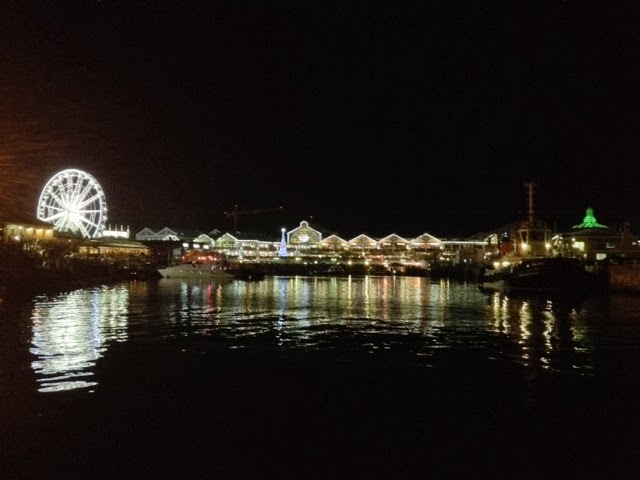
New Year's Eve at V&A Waterfront


It has been a number of years since I spent New Year's Eve at V&A Waterfront, and the even has certainly grown. From the  amphitheatre, the musical acts have now moved to a specially constructed stage on Jetty 1. It means more people can be accommodated, but it makes the music far less intimate - with a wide body of water separating the artists from the crowd.

The highlight event is the fireworks, and this year was spectacular. Some of the fireworks made shapes in the sky - an effect I hadn't seen before. There were some other performers around the V&A - the fire dancer was the most interesting.

31 December 2013

Da Vinci - The Genius Exhibition

Located at the Chavonnes Battery Museum in the Clocktower Precinct, the exhibition does a great job tracing the many contributions of Leonardo Da Vinci. There are reproductions of his notebooks, with great details on his amazing anatomical drawings; there are miniature and a few full size models of his many machines - including the tank, his gliders and artillery weapons. There are reproductions of some of his most famous paintings - and a very detailed look at the Mona Lisa.

It's a great, and fairly thorough exhibition on Da Vinci's many accomplishments. It is a touring exhibition, and the scope in itself is unique. The only criticism I have, is that there not enough focus on the other art works and sculptures.

It runs until February 2014, and is highly recommended.

Sidewalk Cafe


It's a strange place to have a cafe - quiet, posh suburb - but the location on the slopes of Table Mountain leads to amazing views outside. It is a cross between hippy and yuppie - the healthy drinks, the quirky design - and the patrons mostly seem to be stylish yuppies. The food is great, and well priced - a great place for lunch really.


29 December 2013

Franschoek


For some reason, I had never been to Franschoek before today. Famous for its food scene, boasting many of South Africa's top restaurant, it is actually not that far from Cape Town - most trips in Gauteng take longer. 

To be honest, there doesn't seem to be much else, other than food. There are some shops off course, but not I did not find it to be a place to go to do stuff. 

The location is very scenic, and Franschoek pass is a very scenic drive - both for the views of Franschoek on one side, and the rocky ravine on the other. The drive and food are rewards enough.

Kalk Bay Harbour


I love the energy at Kalk Bay harbour - it has a great fishing village vibe, and the wheeling and dealing by the fishing folk as they sell their freshly caught fish is great to watch.


21 December 2013

DW-11-13

DW-11-13 was rated by Eat Out as the best restaurant in Gauteng; and P and I have been meaning to go there for quite a while. With P moving back to the Western Cape, we finally went round to going to DW-11-13 for lunch. While the food is expensive, it was not significantly more than some of the other good restaurants I have been to in Johannesburg; and food was substantially better and is well deserving of its accolades. In particular, the desserts are amazing - and in fact, it is worth going to DW-11-13 just for the desserts.

Movie: Ender's Game

Visually, Ender's Game is magnificent; from the zero gravity fights in the Battle Room to the final space battles; it is a visual feast. Unfortunately, the soul of the book is pretty much taken out - the main story arc is neutered with shortcuts, that doesn't even show the growth of Ender to become the commander - and the side story arcs (especially Peter and Valentine's transformation to Locke and Demosthenes) are almost completely absent. Ender's Game is the type of story that deserves to have the Hobbit treatment - the story needs to be told holistically using all the source material. As a 2 hour popcorn movie; it works - as a visual transcription of an amazing fictional universe; it doesn't.

17 December 2013

Movie: The Hobbit: The Desolation of Smaug

Peter Jackson's epic retelling of JRR Tolkien's children's story continue - with even more inspiration from other sources in the Middle-Earth universe, to tie the Hobbit closer to the Lord of the Rings. Now, Gandalf's frequent periods away from the troupe of dwarves and their hobbit burglar is explained by his side trips to investigate the rise of Sauron. 

IMO, most of the embellishments are welcome - the universe is rich and detailed, and the overall story itself is richer and more compelling through the embellishments (most of which are from actual source material). However, some are just overly distracting - Azog's continual chase of the dwarven party and the inter-species love-triangle - being the main ones for me. 

The other main  gripe for me - is the sudden, inexplicable changes in geography - almost like a Bollywood song & dance routine. One minute they are on a mountain top being chased by wargs, next minute they are running through a field of flowers; still chased by wargs. 

The approach taken in the Hobbit does raise an interesting question - should the entire Middle-Earth universe not be better served with a wider, chronologically perfect, movie/TV series. Tolkien's world is rich with tales, and an epic series would put Game of Thrones to shame. Yes, Smaug in the massive cave with golden treasure is amazing on the big screen - but even a small screen rendition of the entire universe would be worthwhile.

11 December 2013

Ender Series

I first read about Orson Scott Card's Ender's Game, when commentary about the movie started appearing on the web. Intrigued, I read the first chapter at Exclusives, and then got hooked - so got the full series. 

While it is sometimes a straight forward science-fiction novel, what I really like about the series, is the intersection of philosophical discussions on alien interactions - something that is not only applicable with regards to interactions with other sentient species (whose numbers are now far more probable) but also species that seem to be non-sentient. It effectively turns the idea of animal rights on its head - does the fact that humans don't understand communication of other animals on Earth imply that they are not sentient - but rather that we merely can't communicate with them. 

The other key idea is the concept of life itself - specifically, when should a computer program, without a physical presence be considered alive. I did not particularly like the eventual descent into metaphysics of what is the soul - but the very idea of an artificial program that could be alive and is alive in all senses but for the fact that there is no physical body; is a great construct.

It is a brilliant series, and the series had amazing foresight - given that many of the technologies such as the Internet, mobile devices, social media etc. did not exist (or existed only in a very early form) when the series was written. I especially enjoyed the second (Speaker for the Dead) and third (Xenocide) books - and the full series is well worth reading.

08 December 2013

Movie: The Hunger Games: Catching Fire

For many trilogies, the second book is often the bridge with a lot of plot development but little in terms of action. In the Hunger Games series, the second book, Catching Fire, IMO, is the most interesting. The first book introduces the reader to a very impressive dystopian world, and the third book's plot line is rather expected. The second book is a bridge - but the brutality of the Hunger Games world is amazing in its depiction. The movie is quite true to the book's depiction, although not as much time is spent on the game itself. It is a very worthy sequel, and a worthy film translation.

06 December 2013

Goodbye Madiba ...

The first email notification I saw this morning around 5am, on my iPad was an email from J, titled "Nelson Mandela". I didn't read the email then - I was quite sure what it would be about - and it was confirmed when I opened Flipboard - and every other newsite/app. Even Fox News has an obituary - and the only one I saw that referenced the fact that he was listed as a terrorist by the US government.

It was not an unexpected event - he was 95 years old, he was critically ill for a year - but it was a somber day nonetheless. Colleagues even mentioned how quiet and somber it was - not only in the office we were in; but also in other offices.

I don't have a Madiba story - but modern South Africa, is in itself the Madiba story. The remarkable progress made by South Africa is almost unparalleled in other parts of the world that has seen opression - or still have opression in one form or another. That is his biggest gift - and if others can emulate, his biggest legacy. 

Thank you Madiba.

04 December 2013

Movie: The Butler

Based on a true story, The Butler recounts the very inspiring tale of a black man who flees the opressive American South in the early 1900's to eventually become the most trusted Butler in the White House. Forest Whitaker delivers an amazing performance, and is ably supported by a superb cast including Oprah Winfrey (as the alcoholic wife) - superimposing the struggles against racial inequality, the American civil rights movement, and the Butler's front row seat in the heart of the political machinations.

The problem of the movie however, as extensively documented in Wikipedia and elsewhere, is that the story is quite far removed from the truth in many details. The movie is based on a Washington Post article, and the real story, by all acounts is very much worth telling - without embellishment. The fact that so many distorting story naratives are introduced; the actual power of the true story is somewhat lost. It does not take away from an excellent movie - but it does tarnish the real story's power.

29 November 2013

Suitcase

Guitar duo CH2 and cellists from "The Paz Consort", combined to give a great concert melding classical and contemporary music together. It was really a dark, stormy night - maybe a factor in a half full venue at University of Johannesburg's Arts Centre; and it certainly deserved a full house. The guitar work of CH2 is amazing, especially in the virtuoso pieces - but the melding of genres was very impressive. It was certainly worth braving the downpour!

24 November 2013

Parklife Festival - Nov 2013

Planned to celebrate summer, Parklife Festival is set to be a bi-annual concert series; the first one taking place in March this year. While there was a great lineup of bands; SA super band Seether was the real attraction. The organization at Marks Park was excellent, and although the rain threatened throughout (including a few drops), it stayed away.

I had originally thought to go fr Desmond and the Tutus, but M and I went to lunch at 44 Stanley instead; but did make it for Taxi Violence. It has been a long time since I last saw them, and didn't really enjoy them today; so we didn't stay too long. So instead we headed off to the main stage to start staking our places.


One man band, with a few mates, Jeremy Loops was the act before Seether on the main stage. He is certainly a great musician, combining loops of harmonica, vocals, guitar and beat-boxing (all recorded live) - it is quite impressive to see it all come together. The lyrics are fairly simple (and not much to speak of); but he is an interesting act to see live.


There was no point to go see The Dirty Skirts; and rather we decided to et a really good place to see Seether. The Seether set was largely acoustic, and devoid of the stand and deliver approach of the previous shows. It was rather sedate in their standards (after all, in Opikopi last year, Shaun Morgan finished by smashing his guitar) - but it was more interactive, more engaging - and overall a perfect performance for a Sunday afternoon.


Starting the show with the Saron Gas standard - Gasoline, it was really hit after hit. There was a strange lul when they played a cover of a Neil Young song, but every Seether song was sung with gusto by the crowd.

The encore was interesting, as one of the roadies, Brian, joined in for the performance Remedy. It was another great performance by Seether and hopefully the Parklife Festival brings in more great bands in the future.

17 November 2013

ZaCon 5

If ZACon 5 was a true representation of the security practitioners in South Africa, it would seem that there are next to no women - after all, only 1 lady in the audience of 100 plus gives a pretty skewed demographic. Perhaps this is a phenomenon more in the hacker community itself? Perhaps it is due to the fact that the event is on a Saturday? I have commented on diversity of ZACon before, and in other respects the audience was far more diversified, be it race, organisations or age - so, it seems like gender is the final frontier :) 

Organisationally, this was the best ZACon yet - better signage, better communication, up to date scheduling (even if it did run late, and the scheduling did changed a lot), AV and sound set-up etc. As Dominic commented, ZACon is growing up, and it seems to be sustainable footing - and this is a local security conference that deserves to continue. The content was also impressive, covering a variety of interests, although there was a strong "electronics" theme. 

Dimitry started off proceedings on the use of Markov chains to create more efficient password attacks. In principle, it is a great idea, but his actual demonstration and training data was did not make sense. Password complexity rules have almost ruled out the use of plain dictionary words as passwords, and thus the solution did not have the gravitas that it could have.

Jason presented the most interesting talk, on Mains Signalling. Basically, Mains Signalling is the use of signalling on the electrical grid, allowing for controlling of electrical systems. The technology is old, undocumented, and very topical with regards to the move to Demand Side Management, across the world. Through literally years of effort, and off the shelf components, Jason managed to decode some of the signal codes - including that of traffic lights, street lights and geysers. Given that there is absolutely no authentication or authorisation built into the system, anyone with the capability to send modulated signals on the electrical grid can cause havoc - and this is something that, to my knowledge, is not addressed as part of next generation grids. Yes, it is a far more local attack - but also far more economically damaging.

Jeremy ("Panda") presented an interesting investigation on the command and control servers for the Poison Ivy botnet (and two others). Through interception of communication, NMAP and tracking IP addresses and domain registration records; and managed to identify a number of additional domains and command and control servers. And amazingly, many command anc control servers are themselves vulnerable to many attacks, due to bad configuration and vulnerabilities within the Poison Ivy system. The approach will not work for all botnets, but this is certainly a good step forward in combating botnets.

Brazilian Marcos (studying at UJ) presented the most complex talk on detecting obfuscated obfuscation routines.  The use case is better detection of malware, but could also be used to attack software that uses obfuscation as a protection mechanism. Detecting and reversing good obfuscation is difficult and although the presentation is very much in initial stages; it does have good promise.

Rhodes MSc student Adam talked about his research on active honeypots. Traditional security technologies, like firewalls and anti-virus systems have high cost in detection, but low cost in carrying out enforcement. Conversely, honeypots have low cost in detection, but high cost in actually carrying out meaningful actions. The presentation was therefore on building a converged system - low cost of detection, and low cost of enforcement. In some respects it is a better IPS - and the approach is interesting; though probably not completely scalable. 

Dave from MWR's UK office gave the scariest talk of the day - on how it is easy to hijack ad networks to infiltrate ad-supported apps on mobile devices; most notably on Androids and jail broken iPhones. Ads are effectively webkit implementation within apps; but through bad design, vulnerable implementations, intentional wish to hijack data, bad sandboxing, and ads inhering permissions of the underlying apps, ad networks are effectively able to pull various types of data, or take actions such as sending messages or making calls. This means that the attacker can effectively hijack legitimate ads for their own purposes (since ad network traffic is often unencrypted) or in an easier (but potentially tractable) attack, launch an ad campaign that sets out to attack their targets. It was  truly fascinating insight into the problems with the current mobile advertising landscape and the lack of real incentives to address the problems.

Mark, also from MWR, but the SA office, gave an insightful overview of Control Area Networks (CAN), specifically in the cars. While there was some exploration on possible vulnerabilities, it was more of a discussion on reverse engineering. There are interesting avenues to pursue - especially remotely via avenues such as keyless entry or telemetry broadcasts for race cars. 

In the past year, Robert, started a conversation on building a data diode - or a one way transmitter of data. Considering the massive cost (some over 100's of thousands of Rands) of commercial systems, Robert's solution, costing less than R5000, is therefore an amazing hack; and one that works as advertised. 

The last talk was by Shcalk, on designing a low-gain directional Wi-Fi antenna; but was really mostly about 3D printing and house-4-hack. The 3D printer itself has got awards, and this is a good showcase of entrepreneurship. It was a good follow up to Roelof's (from Paterva) talk on the basic building blocks for building a successful business. It was a good way to close off a fascinating day.