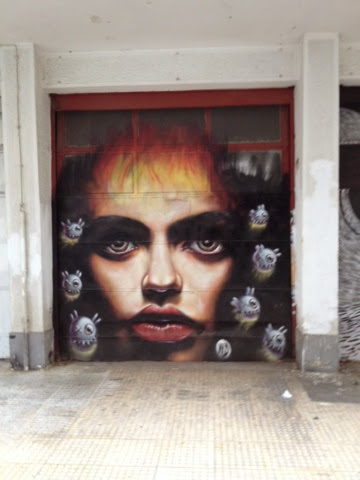
Athens is full of graffiti and other street art; and some of this is probably commissioned by the shops or advertisers. Unlike Lesvos, I didn't see a lot of political protest art; which I found quite strange. The majority of the good art is around the Psyrri suburb; which also had a small Asian community (Bangladeshis and Chinese mainly it seems); but the art didn't seem to have any specific ethnic origin.
About Me
- alapan
- I ramble about a number of things - but travel experiences, movies and music feature prominently. See my label cloud for a better idea. All comnments and opinions on this blog are my own, and do not in any way reflect the opinions/position of my employer (past/current/future).
03 April 2014
02 April 2014
The Sanctuary of Apollo at Delphi
The story of the Oracles at Delphi's Temple of Apollo, are well known. So many stories and myths have the oracles involved, it is one of the central pieces in Greek history.
Delphi fell into disuse fairly soon after Roman takeover of the Greek lands; and although a number of Roman emperors supported Delphi; once Christianity took root, it was soon forgotten. Unlike other sites, there were few conversions to churches and mosques; partly because the site was impacted by earthquakes.
This has also meant that the site is well preserved - there are seemingly more well preserved buildings and statues in this area than all the other ancient Greek sites we have visited this trip.
Delphi also neatly ties in some of the cities we visited on this trip - the demise of Troy was proclaimed by the oracles at Delphi; the serpent column that once stood at Delphi can now be seen in Istanbul (taken by Emperor Constantine) and the kings of Pergamon financed a few Delphi buildings and monuments.
Sadly, the highlight - temple of Apollo is one of the more badly preserved buildings. But the grandeur of the site remains - and if replicas of what is stored in the museum is put up; this site can almost bring back the heyday of Delphi from 2000 years ago!
The Sanctuary of Athena at Delphi
The lesser known temple and site at Delphi, the Sanctuary of Athena is a small site comprising of mostly ruins. It is most notable for Tholos, a round structure whose purpose remains unclear. It is an almost unique structure - and the many adverts for Delphi tours use this as their draw card. The site also offers a great view of the Sanctuary of Apollo.
Delphi Archaeological Museum
The many finds from both the main archeological sites and around Delphi are displayed at the Archaeological Museum, a few metres away from the entrance to the Sancruary of Apollo.
There are some stunning statues and friezes recovered from the sites; and the almost complete large statues are particularly impressive. The friezes have similar themes to the other temples of Ancient Greece, but are older and it has been interesting to study the contrast in quality. The best example is exhibited with the friezes related to the fight between the giants and the gods - earliest depictions in Delphi, later depicted on the Parthenon but the best is from the Altar of Pergamon (which is also the youngest, at around 300 BC).
The highlights are definitely the large statues, including the Sphinx, Argos Twins, the philosopher and the Bronze charioteer; all from the Sanctuary of Apollo. The architecture of the museum lets in a lot of natural light, which really enhances the experience.
The only criticism I have is really with the approach. By taking all the major finds away to the museum, some of the context of the size is lost. Thus, the fact that the Sphinx rested on a near 12m column in front of the Temple of Apollo looses the grandeur of the site. I think the Delphi sites should take an approach similar to that of the Acropolis, and put in replicas in the main archeological site - this way the original can be viewed closely and the grandeur and context of the site can be preserved.
Delphi
Delphi was out last stop in Greece, via a day trip from Athens. We decided to take the public bus option, instead of a tour mainly due to the cost - most tours advertise the day trip around 90 Eur per person and our trip including lunch was around that price!
The bus station in Athens is a bit difficult to get to via public transport and the hotel insisted that a taxi was the best option. On our return we discovered that the metro was not too far a walk; but probably not the best option at 7am in the morning. Incidentally, Athens at 7am was barely awake; a strange phenomenon considering South African rush hour starts at 6:30 am.
Delphi town is perched on a picturesque hillside overlooking a steep valley. Despite the bus loads of tourists, it was strange to see the town quite deserted. Many shops have already closed down and some are on "crisis sales". Somehow, the trickle down effect of tourism is just not working; perhaps because the tour operators are using other towns for lunch time stops; and there are not enough adventurous tourists using the public bus system.
01 April 2014
Lykavittos Hill
Rising behind the trendy suburb of Kolonaki, the hill is one of the highest points in Athens. On top, there is a small church dedicated (it seems to St George) and offers amazing views of Athens, proving that it is not only the ancient Greeks that knew where to build temples!
The 7 Euro funicular is quite expensive for the distance it covers, and its relatively limited service; but the walk up is steeper. The cafe on top is very reasonable in prices, which was surprising given its spectacular views.
Panathenaic Stadium
It's the site of the first modern Olympics, and is based on the design of an earlier stadium from antiquity, also located on the same spot. Unfortunately, it is no longer free entry; so we didn't go inside.
Day Light Saving Time and the Temple of Poseidon
The ancient Greeks really knew where to build their monuments and temples. In a small village outside Athens, called Suino, they built the temple of Poseidon on a cliff at the edge of the Aegean Sea. It is the same location where Aegeus is meant to have jumped off the cliff on the mistaken assumption that his son Theseus (who according to lend would go on to found Athens) died in his battle with the Cretan Minotaur.
The drama of going to and from the temple was worthy of the legends - we took a public bus, but it would only get is half way; whereupon we shared a cab with a Mexican father and son also going to the temple.
The temple itself is renowned for the colours during sunset; which has been around 6:30pm the last few days. With the last bus at 7pm, we thought we got it right; only to discover that due to daylight savings switch the day before, sunset was now at 7:45pm but the last bus was still 7pm. And the last bus, was late in arriving - but still ended up leaving only 5-10 minutes after 7; so the sunset was still missed at the temple.
All said, it was still an amazing sight. It is definitely worth the effort to go there - just don't rely on public transport to see the sunset.
31 March 2014
Ancient Agora
The Agora was the main meeting space for daily life; and the older Ancient Agora (built from 600BC onwards) was the administration centre. It was also the foundation of democracy - not only the proclamation of democratic process; but the council chambers and day to day bureaucratic processes associated with democracy.
Given the historical significance of democracy, it is strange that much of the Agora remains as ruins. The complex has two very well restored sections - the Stoa of Attalos which has an excellent museum on artefacts discovered in the area and a collection of statues; and the Temple of Hephaestus on the opposite side. In between, the site is mostly in ruins - a pity given its significance in the modern political world.
Roman Agora
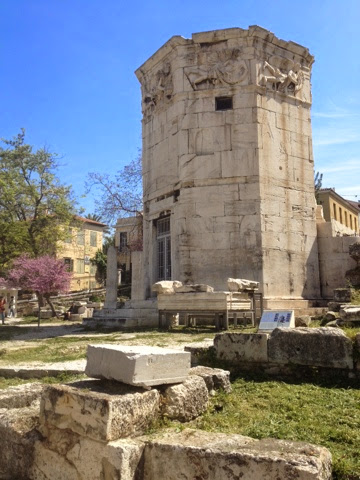
The Agora was the hub of daily life - administration, market etc. The Roman Agora was the extension of the older Agora, and not much has survived - except the Tower of the Wind (used as anastronomical pobservation point) which is mostly intact.
Hadrian's Library
It's a building that has been destroyed, rebuilt, repaired or repurposed a number of times since it was built in 132/133AD by Roman Emperor Hadrian. Then, it was built as a library; but over the course of 1900 years, it has served the purpose of numerous churches, a cathedral, a mosque, fortification, administration centre, barracks, bazaar and more. Destroyed by pillagers of Athens and by earthquakes and fire, what remains is a testament to its size, massive walls and off course archeological restoration.
The size of its walls and remaining columns is impressive, but the highlight is definitely the mostly intact statue of Nike (Godess of Victory) carved from a single block of marble.
Filipappos Monument
South west of The Acropolis, is Filipappou Hill, which is easily accessible, but surprisingly quite devoid of the crowds that throng The Acropolis.
The monument was once very impressive - just based on the remains of the marble statues. But the reason to go up is for the spectacular views of both The Acropolis and the city.
30 March 2014
Acropolis Museum
The Acropolis museum, just outside the main Acropolis complex is itself built on archeological remains of Athens, which is exposed via glass floor and an open section. The museum is effectively in three parts - general finds around the Acropolis, details (including original friezes, sculptures etc) of the Parthenon and details (including original friezes, sculptures etc) of other temples.
Of these, the Parthenon section is the best part, and in the style of the Pergamon museum - the entire set of friezes (or what is left of them) can be viewed, in fairly good detail. As the room is sized to Parthenon's dimensions, nothin is really left out and you get the sense of size of the Parthenon.
Sadly the treatment of the Parthenon is not replicated with the other temples. The main problem with this, is that it is not easy to see how it all fits together in each of the other temples.
The museum is excellent otherwise, and is an excellent stop on the Acropolis circuit.
Theatre of Dionysus
On the slopes of the Acropolis, the Theatre of Dionysus is notable for its collection of marble statues (or rather parts thereof). The theatre itself is only partially restored and the temples are completely destroyed - but it is still an interesting stop on the way out. The Asclepion is also in this stop, but almost nothing remains of that.
Temple of Olympian Zeus
It is one of the largest temples ever, and it took over 700 years to complete. So it's a pity, that all that is left is a mere 15 of the 104 columns that it once had. Started around the same time as The Acropolis, but only finished by Hadrian; the remains have some absolutely humongous columns; and not much else.
Hadrian's Arch
Built under Roman emperor Hadrian, the arch connected the older Greek Arhens centre to the newer Roman expansion. It's interesting in its contrast of styles - Roman at the bottom, Greek at the top - but otherwise not too interesting.
The Acropolis
Many Greek cities have acropolises, but the one in Athens is the one known as The Acropolis. All of the ones we visited this trip (Assos, Troy, Pergamon and Athens) have been dedicated to Athena - though the size and grandeur has differed.
Athens' Acropolis is an amazing set of temples, and unlike Pergamon and Troy; there are no non-religious structures as part of the Acropolis complex.
Going in through the main gate, I was amused to see that it once held the statue of Eumenes II; King of Pergamon who was responsible for much of the Acropolis structures there; he was certainly highly accomplished! The gate still has a lot of renovations underway, and the temple of Athena-Nike is inaccessible.
The Parthenon seems to be perpetually under renovation, but remains an amazing structure. Given the state of other temples we have seen on this trip, the grandeur and attraction of the Parthenon is certainly not misplaced!
The complex of Erechtheion also has a number of scaffolding up, but it is still circumnavigable. The famous maidens of the Caryatids are instantly recognisable, though one cannot get close to them.
Subscribe to:
Posts (Atom)