About Me

I ramble about a number of things - but travel experiences, movies and music feature prominently. See my label cloud for a better idea. All comnments and opinions on this blog are my own, and do not in any way reflect the opinions/position of my employer (past/current/future).

08 February 2014

Buskaid Chamber Concert

St Mary's - a private girls school in one of the richer suburbs in Johannesburg is quite an ironic location to host Buskaid - an ensemble from one of the poorer suburbs of Johannesburg. The Edge, a brilliant auditorium with amazing acoustics paints the gulf between the haves and the have-nots - Buskaid is after all still struggling to add on to their music school.

Buskaid returned for the third year running to the Johannesburg International Mozart Festival, playing yet another eclectic mix of composers, spanning a few centuries; ending off with the Buskaid tradition of kwela. For me, the highlight was Tiisetso Mashishi playing Max Bruch's Romance for Viola and Orchestra Op. 85; but all the pieces were well performed, and well received by an almost capacity audience. 

Buskaid performances are always a highlight and deliver some of the most joyous musical performances on stage. And they definitely deserve to play in the best venues available.

07 February 2014

JPO's 1st 2014 Season, 1st Concert

The 2014 concerts for JPO started this week, and for the first time, I decided to get season tickets. For the last few seasons I have managed to go to almost every concert - and the discount makes sense. The seasons have been shortened to 5 concert weeks this year - perhaps it is a cost saving move. The first concert featured conductor Brandon Phillips from Cape Town, and acclaimed pianist Christopher Duigan from Durban - making it an all South African affair.

The concert started with Liszt's Les Préludes, S97 (Symphonic Poem No.3) - which was a bit longer than I expected, with a lot of different moods - which is explained by the origins of the piece. In fact, the entire piece is like a classic story arch - there is a mostly neutral set-up narrative, followed by arguments and strife concluding with celebration and everyone living happily ever after. It's a great piece to start off the year!

Liszt's Piano Concerto No 1 is one of famous piano concertos,easily recognisable, Christopher Duigan played it brilliantly. I think I enjoyed it more than Ben Schoeman's performance in 2011 - but that could be just due to the passage of time! Christopher Duigan's encore (given seemingly quite reluctantly, after the 3rd round of applause), was a Liszt transcription of a Donizetti opera - was amazing; and got an equally appreciative applause.

Dvořák's 6th Symphony rounded off the evening, and of the evening, my least favourite. To me, it just didn't seem to fit in with the rest of the concert line-up.

01 February 2014

Movie: The Book Thief

Set during World War 2, the story revolves around an adopted girl, Liesel, (it is not completely clear why she is adopted) in a small German town, and the experience of war. Her adopted family hides a Jewish family friend for 2 years, she teaches herself to read - and then falls in love with literature. It is a chronicle of the times where nationalistic songs included hatred of the "non Germans''; where books are burnt and where jobs are dependent on Nazi party allegiances. 

The use of "Death" as the narrator was a stroke of genius in part; spoilt by an annoying voice and some cliched lines. The mangled use of German words in an otherwise English movie is also sometimes annoying; but the story and the acting performances are impressive, especially by Sophie Nélisse as Liesel.

It's a different take on the World War 2 movie - not focused on the politics or the fighting - but rather on the lives the women and children that aren't on the front; and not in the major cities. It's a touching tale of will, hope and bravery; and well worth watching.

26 January 2014

Movie: The Wolf of Wall Street

Despite its many excesses, The Wolf of Wall Street doesn't feel like a long 3 hour movie. It is fast paced, with a dramatic tale of drugs, alcohol, money, sex and greed, based on the life of stockbroker (now turned motivational speaker and sales guru) Jordan Belfort.

The movie features some amazing acting performances - especially by Leonardo DiCaprio and Jonah Hill; and while it does tell the tale from Jordan Belfort's perspective; the impact of the pump-and-dump stock trades is not really explored. Instead, the FBI investigation comes across more as inevitable the fall of the anti-hero rather than arising from actual complaints from harmed consumers. 

Nevertheless, it is a highly entertaining movie, that deserves the rich haul of award nominations (and wins).

Viennese New Year‘s Concert

The opening concert of the Johannesburg International Mozart Festival, was effectively a tribute concert to the Viennese New Year's concerts - a concert with a lot of light, happy music. There were a lot of polka and waltzes (many penned by a Strauss), a few operettas (one even penned by Mozart) and a few other well known highlights. 

One of the great things about Richard Cock as a conductor in these types of events, is how he gets the crowd involved and informed - be it little snippets on the pieces about to be played, or getting the crowd singing or clapping along. It certainly makes these concerts a lot more accessible; than the typical classical music concerts.

25 January 2014

Talking and Feeling Plants

One of the main arguments made by vegans and vegetarians supporting their food choice relates to not causing animals pain. The argument is quite compelling, especially given many modern, high volume, farming methods - but it is usually hypocritical, in that the defence of animals rarely extends to insects and other less "cute" animals.

Some recent studies now seem to close down the argument on plants not feeling pain. The Economist has a very interesting article reviewing work showing, experimentally, that not only do plants feel pain, but they also have the capacity to remember the circumstances when they felt pain. Another article in Wired, had a discussion on plants communicating warning between each other - although this was restricted in terms of location and species of plants. 

This is quite interesting beyond just the concept of plants being sentient (although I think Ents are a bit far off). It extends our own understanding of what biological constructs may exist for nervous systems - and that the traditional known nervous systems are not the only ones. Perhaps, in one of the planets out there, there is a sentient species that are just like Ents :)

18 January 2014

Why the e-tag?

I first heard about the Gauteng Freeway Improvement Project in 2008 - and that included a fairly detailed discussion on how the project was going to be paid for - tolling. The discussion document, compiled by a senior manager at a large construction company, provided views of the work packages, proposed designs for new interchanges, the proposed timelines for the work and the proposed toll fee of 50c per KM.

I don't like the idea of tolling - but in my opinion OUTA's (and for that matter COSATU and the DA) actions were largely misdirected. Tolling came across, because of a single failure - politicians across the board (from every party) - be it local government, provincial government or national government - not doing their jobs. It is after all their responsibility to vet proposed actions, such as road improvements. And the tenders were all public documents; well advertised - the people who were elected to look after such things, didn't. And a few years after the projects were awarded, it became a hot button issue.

While a lot has been made of the tolling process - one of the questions I haven't seen being raised, is why the e-tag? Let's take the system without e-tags; which is fully functional whether you are registered or not. When a car goes under the gantries, the license plates are captured; and the number plate is deciphered. If the number plate is linked to a registered account, appropriate discounted charges are calculated and deducted from the account. If the number plate is not linked to a registered account, the charges are compiled; and after a certain period of time, an invoice is sent through based on the vehicle registrations details.

So what value does the e-tag add? Firstly, it is not necessary to get the discounted rates. Secondly, it is not transferable - it can only be used with one vehicle. It does not help with unlicensed vehicles - since those vehicles can't get e-tags anyway. In fact, the only benefits I can see are 1) the double-beep to tell you that the account is getting too low and 2) reuse in other toll roads that support e-tags (which don't have cameras). People who use the roads covered by earlier verision of e-tags regularly, already have e-tags - and the use case is easier to defend - pay on the spot, or use an e-tag. That doesn't extend to open-road tolling.

But the whole e-tag infrastructure adds additional cost; additional RFID readers, additional tags, the whole registration process etc. Instead, a more rational process with open road tolling would have been to simply issue accounts -  just like the municipalities do - and provide discounts for early payment, and penalties for late payment. And just like any credit process, provide for debt collection. Registration or pre-paid accounts can also be handled through the same process - but just adds extra administration overhead. 

Instead, with the added complication of registration and e-tags, SANRAL has gotten itself lots of headache and delays - with absolutely no additional benefits.

11 January 2014

Movie: Carrie

I have not read Stephen King's book, nor have I watched the earlier versions of this movie. Carrie, a quiet and reclusive teen brought up by her very religious mother (brilliantly portrayed by Julianne Moore), gets bullied in school, discovers that she has telekinetic (and other) powers (naturally from the devil), and has a meltdown that takes out the whole school when the bullying goes overboard. It's better than most teen (or is it young adult?) movies and good entertainment; but nothing spectacular.

08 January 2014

Movie: Jeune & Jolie (Young and Beautiful)

The plot is fairly simple - a young woman (girl?) looses her virginity, but doesn't enjoy the experience - during her summer holidays. Back home, she becomes a secret call girl - mainly catering to rich, old men; where she experiences a wide range of sexual activities - although; except for one "john", she doesn't ever seem to actually enjoy the experience.

The movie makes no moral judgement (though it does present various sides of the arguments around prostitution) - neither does it present any motivation on the choice of becoming a prostitute. It is like a study of a rebellious teenager - but one that doesn't draw any conclusions, nor offers any theories. 

And, in that respect, the movie was unrewarding.

05 January 2014

Is it worth it?

In Bruce Shneier's TED talk from 2011, he comments that the critical question on security is "is the tradeoff worth it?". In the whole NSA debate, there has been much written and commented about the programmes, the programmes' impact on individuals' rights to privacy (both American and foreign citizens) and the ethics around such a programme.


However, the question on whether the NSA programme's trade-offs were actually worth it - as in a full cost benefit analysis, has only been tangentially discussed. In this regard, a paper by Mueller and Stewart, provides a good overview of the cost benefit analysis. Even, in the absense of numerical values, the benefits provided by the programme are actually quite low.

The paper is a vital discussion that has, so far been poorly addressed. More than anything else - surely a programme that costs billions, but has very little identifiable benefits, should be seen as fruitless expenditure. Given the US's current political stances on budget defecit - it almost seems like cutting the NSA programmes themselves will address the gap!

02 January 2014

New Year's Eve at V&A Waterfront


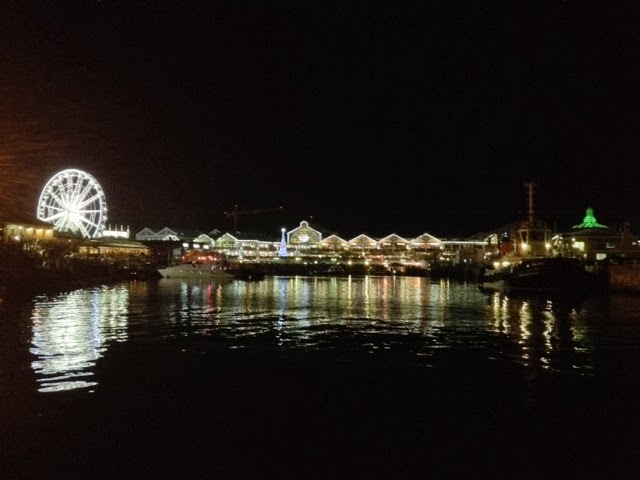
It has been a number of years since I spent New Year's Eve at V&A Waterfront, and the even has certainly grown. From the  amphitheatre, the musical acts have now moved to a specially constructed stage on Jetty 1. It means more people can be accommodated, but it makes the music far less intimate - with a wide body of water separating the artists from the crowd.

The highlight event is the fireworks, and this year was spectacular. Some of the fireworks made shapes in the sky - an effect I hadn't seen before. There were some other performers around the V&A - the fire dancer was the most interesting.

31 December 2013

Da Vinci - The Genius Exhibition

Located at the Chavonnes Battery Museum in the Clocktower Precinct, the exhibition does a great job tracing the many contributions of Leonardo Da Vinci. There are reproductions of his notebooks, with great details on his amazing anatomical drawings; there are miniature and a few full size models of his many machines - including the tank, his gliders and artillery weapons. There are reproductions of some of his most famous paintings - and a very detailed look at the Mona Lisa.

It's a great, and fairly thorough exhibition on Da Vinci's many accomplishments. It is a touring exhibition, and the scope in itself is unique. The only criticism I have, is that there not enough focus on the other art works and sculptures.

It runs until February 2014, and is highly recommended.

Sidewalk Cafe


It's a strange place to have a cafe - quiet, posh suburb - but the location on the slopes of Table Mountain leads to amazing views outside. It is a cross between hippy and yuppie - the healthy drinks, the quirky design - and the patrons mostly seem to be stylish yuppies. The food is great, and well priced - a great place for lunch really.


29 December 2013

Franschoek


For some reason, I had never been to Franschoek before today. Famous for its food scene, boasting many of South Africa's top restaurant, it is actually not that far from Cape Town - most trips in Gauteng take longer. 

To be honest, there doesn't seem to be much else, other than food. There are some shops off course, but not I did not find it to be a place to go to do stuff. 

The location is very scenic, and Franschoek pass is a very scenic drive - both for the views of Franschoek on one side, and the rocky ravine on the other. The drive and food are rewards enough.

Kalk Bay Harbour


I love the energy at Kalk Bay harbour - it has a great fishing village vibe, and the wheeling and dealing by the fishing folk as they sell their freshly caught fish is great to watch.


21 December 2013

DW-11-13

DW-11-13 was rated by Eat Out as the best restaurant in Gauteng; and P and I have been meaning to go there for quite a while. With P moving back to the Western Cape, we finally went round to going to DW-11-13 for lunch. While the food is expensive, it was not significantly more than some of the other good restaurants I have been to in Johannesburg; and food was substantially better and is well deserving of its accolades. In particular, the desserts are amazing - and in fact, it is worth going to DW-11-13 just for the desserts.

Movie: Ender's Game

Visually, Ender's Game is magnificent; from the zero gravity fights in the Battle Room to the final space battles; it is a visual feast. Unfortunately, the soul of the book is pretty much taken out - the main story arc is neutered with shortcuts, that doesn't even show the growth of Ender to become the commander - and the side story arcs (especially Peter and Valentine's transformation to Locke and Demosthenes) are almost completely absent. Ender's Game is the type of story that deserves to have the Hobbit treatment - the story needs to be told holistically using all the source material. As a 2 hour popcorn movie; it works - as a visual transcription of an amazing fictional universe; it doesn't.

17 December 2013

Movie: The Hobbit: The Desolation of Smaug

Peter Jackson's epic retelling of JRR Tolkien's children's story continue - with even more inspiration from other sources in the Middle-Earth universe, to tie the Hobbit closer to the Lord of the Rings. Now, Gandalf's frequent periods away from the troupe of dwarves and their hobbit burglar is explained by his side trips to investigate the rise of Sauron. 

IMO, most of the embellishments are welcome - the universe is rich and detailed, and the overall story itself is richer and more compelling through the embellishments (most of which are from actual source material). However, some are just overly distracting - Azog's continual chase of the dwarven party and the inter-species love-triangle - being the main ones for me. 

The other main  gripe for me - is the sudden, inexplicable changes in geography - almost like a Bollywood song & dance routine. One minute they are on a mountain top being chased by wargs, next minute they are running through a field of flowers; still chased by wargs. 

The approach taken in the Hobbit does raise an interesting question - should the entire Middle-Earth universe not be better served with a wider, chronologically perfect, movie/TV series. Tolkien's world is rich with tales, and an epic series would put Game of Thrones to shame. Yes, Smaug in the massive cave with golden treasure is amazing on the big screen - but even a small screen rendition of the entire universe would be worthwhile.

11 December 2013

Ender Series

I first read about Orson Scott Card's Ender's Game, when commentary about the movie started appearing on the web. Intrigued, I read the first chapter at Exclusives, and then got hooked - so got the full series. 

While it is sometimes a straight forward science-fiction novel, what I really like about the series, is the intersection of philosophical discussions on alien interactions - something that is not only applicable with regards to interactions with other sentient species (whose numbers are now far more probable) but also species that seem to be non-sentient. It effectively turns the idea of animal rights on its head - does the fact that humans don't understand communication of other animals on Earth imply that they are not sentient - but rather that we merely can't communicate with them. 

The other key idea is the concept of life itself - specifically, when should a computer program, without a physical presence be considered alive. I did not particularly like the eventual descent into metaphysics of what is the soul - but the very idea of an artificial program that could be alive and is alive in all senses but for the fact that there is no physical body; is a great construct.

It is a brilliant series, and the series had amazing foresight - given that many of the technologies such as the Internet, mobile devices, social media etc. did not exist (or existed only in a very early form) when the series was written. I especially enjoyed the second (Speaker for the Dead) and third (Xenocide) books - and the full series is well worth reading.

08 December 2013

Movie: The Hunger Games: Catching Fire

For many trilogies, the second book is often the bridge with a lot of plot development but little in terms of action. In the Hunger Games series, the second book, Catching Fire, IMO, is the most interesting. The first book introduces the reader to a very impressive dystopian world, and the third book's plot line is rather expected. The second book is a bridge - but the brutality of the Hunger Games world is amazing in its depiction. The movie is quite true to the book's depiction, although not as much time is spent on the game itself. It is a very worthy sequel, and a worthy film translation.